Anita Mathias: Dreaming Beneath the Spires

Anita Mathias's Blog on Faith and Art

  • Home
  • My Books
  • Meditations
  • Essays
  • Contact
  • About Me

Archives for July 2010

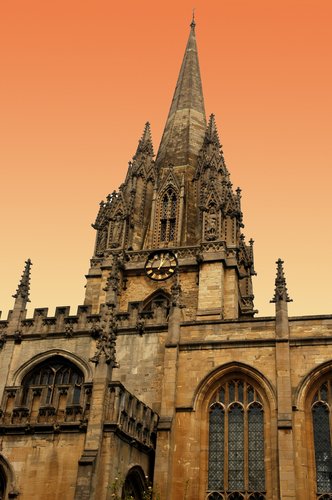
Exploring The Museum of Oxford, St. Aldate’s. A glimpse into Oxford’s history

By Anita Mathias


The Museum of Oxford

Zoe is in Exmoor on a 3.5 day hike with her friends for the Duke of Edinburgh expedition. Serendipitiously, she is v. fond of all the three other girls with her, so they should have a great time, even though the bonds of friendship will, no doubt, be tested to the uttermost.

We and Irene had a great morning in the interesting Museum of the History of Oxford. There were artefacts from paleolithic and neolithic times and a good Roman collection. You know, I didn’t know the Romans were in Oxford. We  enjoyed the kilns and pottery, with the potter’s signature.

The Romans introduced a lot of herbs to English cooking–parsley, chervil, coriander, garlic, onions, sage, rosemary–which have continued to be used ever since.  They introduced their two favourite foods–sauces and sausages, which likewise  have lingered.

Then came the Saxons. I didn’t realize before that the City of Oxford grew around Friedeswide’s Minster, the site on which Christ Church Cathedral now stands. So Christianity has always been at the heart of the City of Oxford!

I have lived in Oxford for 8.5 years, so you can imagine the pleasure with which I am taking my children to the Museum of the History of Oxford. 

This week, we looked at the Danish invaders to Oxford, who burnt down the wooden city. After that, Oxonians built in stone. The main thoroughfares (High street, Cornmarket, Queen’s street, St. Aldate’s) were around, and commercial centres in the 10th century. And so many names one still hears are from the Danish invaders. 

Medieval feasts were displays of wealth. They could take 6 months to prepare, and were eaten on pieces of bread as trenchers, with a knife, and one’s fingers!! Forks were not yet invented. 

I love Oxford. There is no place I would rather live!

We watched a good 15 minutes film on the history of Oxford, then used the excuse that 11 year olds need to be fed regularly to take Irene to Nandos.

Absolutely delicious grilled piri-piri chicken, which  I have never had before. I would give a good deal for the recipe, and for Roy to learn to cook it.

Filed Under: In which I Dream Beneath the Spires of Oxford

Young Woman with a Water Pitcher by Jan Vermeer: A Taste of Mysticism in the Midst of Domesticity

By Anita Mathias

Young Woman with a Water Pitcher, Johannes Vermeer

I love this painting, partly because I identify with it. It is the way I do housework, as my husband can testify with great exasperation.

It depicts a mystical moment, a respite in the middle of duties and domesticity.

Wordsworth thus described these mystic moments of illumination which come unbidden
“another gift,
Of aspect more sublime; that blessed mood,
In which the burthen of the mystery,
In which the heavy and the weary weight
Of all this unintelligible world
Is lighten’d–that serene and blessed mood,
In which the affections gently lead us on,
Until, the breath of this corporeal frame,
And even the motion of our human blood
Almost suspended, we are laid asleep
In body, and become a living soul:
While with an eye made quiet by the power
Of harmony, and the deep power of joy,
We see into the life of things.”

And these can happen even in the thick of domesticity!!

There is yet another poem which comes to mind when I think of Vermeer, one from Tagore’s Geetanjali.

I ask for a moment’s indulgence to sit by thy side. The works
that I have in hand I will finish afterwards.

Away from the sight of thy face my heart knows no rest nor respite,
and my work becomes an endless toil in a shoreless sea of toil.

Now it is time to sit quiet, face to face with thee, and to sing
dedication of life in this silent and overflowing leisure.

Filed Under: random

Charles and John Wesley and the Holy Club

By Anita Mathias

I recently took a Christian history class with Ken Barnes through Oxford University’s Continuing Ed. I enjoyed the lecture on Charles and John Wesley and the Holy Club. One of the things the “Holy Club,” (their derogatory nickname, a bit like today’s God Squad) did was to read the Bible together in the Koine Greek, Novum Testamentum Graece.

I took some classes in Classical Greek when I was at Oxford, and still retain enough to read Scripture in Koine Greek. I firmly believe it gives one much of the flavour and feel of the original which is lost in translation.

However, being patient and kind, not jealous or boastful, not arrogant or rude is no easier, whether you read the injunction in English, Greek, French or Hindi, and I have just read it in all my four loved languages!!


Filed Under: random

Books and the Iphone

By Anita Mathias

Liked the book? Try the app

Eager to find new ways to involve his readers in the mysteries of numbers, mathematician Marcus du Sautoy looked to new technology. A revolution is coming, he argues, and the whole idea of what a book can do is about to change
  • Digg it
  • Buzz up
  • Share on facebook (37)
  • Tweet this (123)
  • Comments (12)
  • Marcus du Sautoy
  • The Guardian, Saturday 3 July 2010
  • Article history
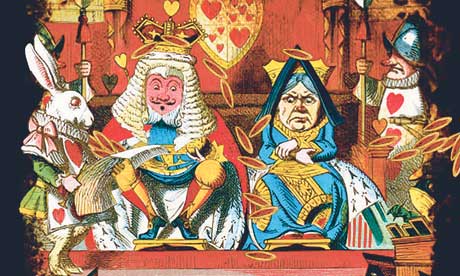
from Alice in Wonderland for the iPad
Illustration from Alice in Wonderland on the iPad. Photograph: Atomic Antelope
Consider two books: Hilary Mantel’s Wolf Hall and Lewis Carroll’s Alice in Wonderland. Not the printed books, the apps – software for mobiles and the iPad. The Wolf Hall app is a thing of beauty. It contains the text, of course, but readers can also move slickly between the text, family trees of the Tudors and the Yorkists, extra articles by Mantel and a fascinating video discussion between the novelist and historian David Starkey. All of which gives a deeper and richer understanding of the novel’s historical context and its characters.
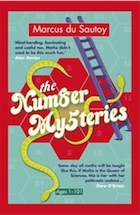
  1. The Num8er My5teries: A Mathematical Odyssey through Everyday Life
  2. by Marcus du Sautoy
  3. 320pp,
  4.  

  5. Fourth Estate,
  6. £16.99
  1. Buy The Num8er My5teries: A Mathematical Odyssey through Everyday Life at the Guardian bookshop
But this is nothing compared to Alice for the iPad. You can throw tarts at the Queen of Hearts, help the Caterpillar smoke his hookah pipe, make Alice grow as big as a house and then shrink again. You can watch as “the Mad Hatter gets even madder”, and throw pepper at the Duchess. Over the 52 pages of the app there are 20 animated scenes. Each illustration has been taken from the original book and has been made gravity-aware, responding to a shake, tilt or the touch of a finger. The story is never the same twice, because users are Alice’s guide through Wonderland. The Caterpillar will smoke his hookah in a new way when you tilt your iPad, or you can throw more pepper the second time around.
It would have been quite simple to convert the printed files of Carroll’s book and drop it straight on to the iBookstore, but what Atomic Antelope (atomicantelope.com) has done, through painstaking artistry, is to capture, for adults and children alike, the fantastical nature of the story. This is about recreating what a book is and can be. With the advent of new technology – devices such as the iPhone or iPad, the Sony Reader or the Kindle – authors and publishers are being offered a huge challenge: to reconceive their content to provide a visual and interactive experience that the printed book cannot provide. Art books with huge numbers of accessible images; architecture books with 3D plans of buildings; travel books with videos and interactive maps; children’s books with games and characters who introduce themselves; and so on and on. The potential is vast. This is not a case of simply trying to cram written content on to an e-reader; this is about taking that content and completely reinventing it.
Currently readers are being offered little more than the novelty of a book on an electronic device, but the thrill of turning the page by clicking a button quickly pales. Many of the current projects are just tarted-up books for electronic media, but if it doesn’t move the experience on to a new level, to enhance the material, what’s the point? What authors and publishers need to do is to go back to the drawing board and, at the moment ideas are conceived, work out how – if at all – to make use of these new toys.
Before we get too cross-eyed about what the technology can do, there are a number of caveats. In 80 days Apple sold 3m iPads worldwide. It’s a staggering amount, but on the tube people reading books outnumber those reading from iPads by more than 100 to one. And books are a great invention. They are durable, portable. Their batteries don’t run out. They look great, and it is much easier to show off that you are reading Tolstoy in the original with a paperback than it is on an e-reader. Perhaps most important, the rules for publishing, say, Annie Proulx’s short stories are not the same as those for publishing Simon’s Cat on a portable Playstation. What can and should be done with one type of book will not necessarily translate to another.
Non-fiction surely provides more potential than fiction. It’s difficult to see what else could be done with a novel such as Wolf Hall, however elegant the app. (And to read the novel on an iPhone would take 40,000 swipes or tilts of the screen.) The exception is children’s fiction. Already game developers and publishers are working on augmented-reality books that follow on from Mobile Art Lab’s PhoneBook, available from Amazon Japan, a hybrid that combines the iPhone with an ordinary book. The iPhone is placed inside the covers of a picturebook and, as you turn the page, you simultaneously turn the page on the iPhone to reveal interactive imagery.
Non-fiction is different again. What is a footnote, after all, but an attempt to break out of the linear structure of a book? How reference books could change can now begin to be imagined, but I’m particularly interested in apps for non-fiction that are not designed to break up a narrative in a radical way, but rather to augment a storyline – for me, non-fiction works best when it tries to emulate the narrative that drives a reader to the end of a novel.
To understand how to make the most of the new technology, I decided to go back to first principles and analyse what it is that I do as a mathematician and a writer. My job is, as the jargon goes, to “deliver content” in as many different forms and to as many different people as possible. I prove theorems; I present TV and radio programmes; lecture in schools, universities, prisons and to government; I collaborate with theatre companies and composers to create artistic pieces that explore mathematical themes; and I’ve worked with games developers to create mangahigh.com, an internet maths school that allows students to play and get better at maths. None of this will change. Now, however, technology has become so sophisticated in the way it engages its users that I can bring something of the experience of TV and lecturing to the books I write.
My new book, The Num8er My5teries, could have been written before the advent of the digital age and the arrival of smartphones and web-browsing ereaders. But these technologies offer new possibilities. The book is being launched in conjunction with a gaming app, and is an interactive experience: for the first time, I’m using technology to bring the maths alive – to demonstrate, in real time, problems that until now have been explained only in ink or in person.
As the book evolved, it became clear that it was bursting to get free of the constraints of the page. Mathematics is not a spectator sport. You want your readers to get their hands dirty, exploring, investigating, playing and achieving their own “aha” moments. The book contains mathematical experiments that explore the dynamics of population growth, experiments that are best appreciated by doing them yourself; and there are games whose mathematical strategies the reader can try out on the app.
The experience is still highly text-based; it’s not a book that would work better as a website, and it’s far from a videogame. It has a strong narrative line, telling the story of five of the greatest unsolved problems in mathematics. The first mystery is the challenge of finding a pattern behind the enigmatic prime numbers. A curious cicada in north America turns out to have been the first species to embark on an exploration of these numbers. The book describes an experiment that helps readers to explore why primes might have been the key to the evolutionary survival of this strange insect. But it is the unpredictability of these numbers as one climbs through the universe of numbers which represents one of the biggest mathematical mysteries. A game of prime number hopscotch gives the reader a real feeling for their wild behaviour, as do the page numbers, which vary according to whether they are prime or not.
Other mysteries include the search for the elusive shape of the universe. Exploring the bagel shape that hides behind the 1970s videogame Asteroids turns out to be the best warm-up to navigating the four-dimensional contours of our real universe. The ability to predict certain developments in the future using the equations of maths is something that not only mathematicians but also climate scientists, astronomers and economists would love to develop.
One chapter has games at its heart. Mathematics is a very powerful tool for producing winning strategies in a range of games, from Monopoly to chocolate-chilli-roulette, from the lottery to the roulette wheel. But there are some games that are currently beyond the limits of mathematics. It is these unsolved mysteries which make it a living subject, constantly evolving, changing and surprising.
The Num8er My5teries draws heavily on technology from Japan, and features, among the games and puzzles, Quick Response (QR) codes. These are rather peculiar-looking barcodes that, when you take a photo of them with your smartphone, will take you out of the book to different websites to show you maths in action. My favourite is the video I’ve included of Roberto Carlos demonstrating chaotic and laminar turbulence in one of the most staggering free-kicks ever taken in the history of football . Watching a video of Carlos bending the ball delivers something that no explanation in words or still photos ever could. These QR codes were first used on a dating site where teenagers would wear a T-shirt with a code on the back – if you were interested, you took a photo, followed the link to the website and got in touch.
The Num8er My5teries is still intended to work as a traditional literary experience – to provide a place in which to immerse yourself for more than just a few clicks through pages on the web. It is still principally linear, with a narrative to take you from A to B. But it also aspires to be something different, something more than a book. The games and experiments are there to get the reader actively involved. As Clay Shirky’s new book Cognitive Surplus argues, the internet, computer games and mobile devices are creating a new generation of active producers and sharers of content, rather than passive consumers. New technology, far from dumbing us down, is getting us involved in building a more engaged, democratic and creative world.
Ebooks and apps make it possible to reconceive books for devices that people use to email, call, play games and tweet, in a way that allows an author to reach people who have rarely bought books before. Conversations have begun between publishers and the gaming industry, who previously have had nothing to say to one another.
The future offers much more. One of the most intriguing prospects for me is to use social networking facilities to conduct mass-participation experiments to explain the science discussed in a book. You can already download for nothing an app that allows you to join the Galaxy Zoo project to help astronomers explore the universe. Twitter and Facebook offer the opportunity to create communities bound together by the experience of reading a particular book. The app that lets you read the series of Scott Pilgrim comics on your smartphone is already exploiting the power of social networking to create dialogue between readers, who use the characters from the comics as their avatars.
Authors and composers have for centuries explored ways for readers or listeners to have some involvement in the act of creation – to navigate their way through a piece to create a unique, personal composition. Obvious problems are encountered. Mozart’s Musikalisches Würfelspiel, or musical dice game, produces a different waltz according to the throw of the dice (it is available through an app). The game can produce around 46 million billion different waltzes. Played one after the other, it would take 200m years to hear every waltz. But none of the waltzes compares to any of the compositions that Mozart had total control over.
BS Johnson’s notorious 1969 novel The Unfortunates was unbound and published in a box. The first and last chapters are fixed but readers can choose the order of the 25 chapters that form the body of the book. That’s 15,511,210,043,330,985,984 million different books. The French writer Raymond Queneau, co-founder of the Oulipo movement, provided readers with even more options with his sequence of sonnets in which there is a choice of 10 different versions for each of the 14 lines of the sonnets. Like Mozart’s dice game, this produces work that would take over 200m years to recite. For me, it is a mathematician, Henri Poincaré, who best sums up the problems with these attempts: “To create consists precisely in not making useless combinations. Invention is discernment, choice . . . The sterile combinations do not even present themselves to the mind of the inventor.”
But that doesn’t mean that the new technology doesn’t offer readers a chance gratifyingly to navigate their own passage through a narrative. The challenge of how to use this technology without breaking the narrative experience shares something with television trying to discover what it can do creatively with the red button to enhance rather than interrupt the viewer’s experience. It’s a problem TV has not really been able to crack yet.
The gaming industry has probably made most progress with creating interactive narratives. The Playstation3 game Heavy Rain allows players to make choices at points during the game, resulting in a seamless film-noir experience that varies from player to player. Because you’re responsible for the death of a central character in the closing sequences, you feel more emotionally involved. Fable II for Xbox sees your character morphing, becoming more or less evil, fatter or thinner, according to your actions. Bodies such as the Independent Game Developers’ Association are now seeking out traditional “content providers” to collaborate on new digital projects, and some authors are being drawn to experiment with writing for the gaming industry. Graham Joyce, who has won the British Fantasy award four times, was hired in 2009 to write the storyline for the fourth instalment of the shoot-’em-up videogame Doom.
Such collaborations are beginning to break down barriers. Three years ago the government launched a scheme to provide funding to UK companies that collaborate on digital initiatives in an attempt to stimulate new ideas. Similarly, Artist’s eBooks (artistsebooks.org) has been set up to explore “new platforms and formats” for authors. One book that it features, Niven Govinden’s L’histoire de Bexhill Baudelaire, includes links to YouTube videos which comprise the book’s soundtrack.
Marvel Comics’ app gives you access to more than 500 comic books, featuring Iron Man, Captain America, Spider-Man, Hulk, Thor and more of the world’s most popular superheroes. The app brings the world of Marvel to iPad owners with each comic presented at high resolution, and includes a search engine and innovative viewing options. But apps such as this also often feature a comic shop locator, allowing users to source a local retailer – an indication that the app editions are at present being seen as supplementary to the printed book, not a cannibalisation of an existing market. (I am very grateful to Robin Harvie of Fourth Estate for many of these examples.)
In January, the Diary of Samuel Pepys app was launched – iPhone and iTouch users are sent the relevant diary entries for each day. This, of course, is merely offering a new way to read wonderful things. Writing for new platforms – Japanese mobile phone novels, such as Deep Love by “Yoshi”, are an obvious example – is only just beginning. (For a taste, see theliteraryplatform.com.)
Though one of the central themes of The Num8er My5teries is the power of mathematics to work out what will happen next, maths isn’t much use in predicting the shape that books will take in the decades to come. The nature of literary fiction is unlikely to change, but in different areas of publishing new developments are inevitable. Reading experiences can take many forms. I am always on the lookout for new ways to convey the excitement of my subject, and have now begun to take advantage of the amazing new technology being developed to enrich a reader’s experience. Things are changing fast. Like every writer, I’m already thinking about the next book. But when it arrives, it may not look the way you expect it to.

Filed Under: books_blog, Literature and technology

"One tongue is enough for a woman" Mother Teresa.

By Anita Mathias

“One tongue is enough for a woman” Mother Teresa.

I had my first powerful experience of the Holy Spirit when I was 17 and a Spanish priest, Fr. Marcellino Iragui prayed that I would receive the baptism in the Holy Spirit.

I did.

Hey, this was India, and anyway, religion and authoritarianism are always closely linked. So I repeated the prayer for the Holy Spirit after him (I’ve always objected to repeating prayers after people).

When we came to “And Lord, please give me the gift of tongues,” I said, “No, I don’t want that. My father will make fun of me.”

He said, “You can’t pick and choose among the gifts of God.”

And so I prayed. And felt nothing. And felt relieved.

And woke up at night with a sense of overwhelming joy, joy so intense that I was, in fact, close to tears. I praised God in ecstatic, broken, joyful English.

And in a language I hadn’t learned. Tongues! Goodness!

I joined Mother Teresa’s convent a month or two later. And, when I met with her, I asked, “Mother, what do you feel about the gift of tongues?”

She had reached the dangerous age. The age at which one instinctively dismisses new ideas. (Oh dear, I feel that age coming upon me, and am valiantly resisting it!)

She answered, “One tongue is enough for a woman.”

And that was that. I was 17.

Thankfully, the gifts of God are irrevocable, and I pray in tongues today, though not as much as I should.

Sadly, true for both praying. And praying in tongues.

I think I will go and do both right now!!

Filed Under: random

Money and Happiness

By Anita Mathias

MONEY MADE BY PLAYING IS SWEET

That money can’t buy happiness is an old, sage, and utterly true aphorism. Of course, of course!

However, there is one sort of money, which at least initially does buy happiness. At least, in both my experience and Roy’s. At least initially.

And that is (since one does need money to live, unless you have the balls to live like Thoreau or the Moneyless Man http://www.guardian.co.uk/environment/blog/2010/jun/02/mark-boyle-moneyless-man-food-for-free) when one makes money by doing something one so enjoys that is is more play than work.

Making money by writing.
By blogging.
By following a business hunch that proves  profitable.

And oddly, the few quid made from google adsense on a blog post one had so much fun writing can give one more happiness that a grander paycheck from work that was toil, sweat, tears and thorns.

Filed Under: random

Experiencing the Love of God in the Desert

By Anita Mathias

The Desert

Who would want to live there? Little food, water, noise, distraction, companionship, colour.

Just the vast starry skies, the sun by day, the moon by night.
And God.

And God.

And because no one would choose to live there, God sometimes forcibly herds us there, to reveal himself to us in that atmosphere so devoid of sensory stimulation.

I have not always lived in the desert.
I have had years of full diaries, every social invitation accepted,   my head echoing with happy conversation.

This is a quiet period.
I could escape it, fill with it noise and activity, but I will not.

* * *

Who is this coming up from the desert leaning on her lover? (Song of Solomon 8:5)
When we are in the desert, we get to know God. We learn to lean on him because there is little else to lean on.

In Hosea 2, God allegorically talks about an unfaithful and distracted worshipper.

“Therefore I will block her path with thorn bushes;
I will wall her in so that she cannot find her way.

“Therefore I am now going to allure her;
I will lead her into the desert
and speak tenderly to her.
15 There I will give her back her vineyards,
and will make the Valley of Achor (Trouble) a door of hope.
There she will sing as in the days of her youth.”

Or, as it says in another translation, “Into the desert, I will lure her. There I will show her my love.”

So okay, Lord, I will willingly be lured into the desert. Dance with me there. Show me your love.

Filed Under: random

To whom do words belong? Plagiarism and the Creative Process.

By Anita Mathias

SOMETHING BORROWED
Should a charge of plagiarism ruin your life?
by Malcolm GladwellNOVEMBER 22, 2004
LARGE TEXT

One day this spring, a psychiatrist named Dorothy Lewis got a call from her friend Betty, who works in New York City. Betty had just seen a Broadway play called “Frozen,” written by the British playwright Bryony Lavery. “She said, ‘Somehow it reminded me of you. You really ought to see it,’ ” Lewis recalled. Lewis asked Betty what the play was about, and Betty said that one of the characters was a psychiatrist who studied serial killers. “And I told her, ‘I need to see that as much as I need to go to the moon.’ ”
Lewis has studied serial killers for the past twenty-five years. With her collaborator, the neurologist Jonathan Pincus, she has published a great many research papers, showing that serial killers tend to suffer from predictable patterns of psychological, physical, and neurological dysfunction: that they were almost all the victims of harrowing physical and sexual abuse as children, and that almost all of them have suffered some kind of brain injury or mental illness. In 1998, she published a memoir of her life and work entitled “Guilty by Reason of Insanity.” She was the last person to visit Ted Bundy before he went to the electric chair. Few people in the world have spent as much time thinking about serial killers as Dorothy Lewis, so when her friend Betty told her that she needed to see “Frozen” it struck her as a busman’s holiday.
But the calls kept coming. “Frozen” was winning raves on Broadway, and it had been nominated for a Tony. Whenever someone who knew Dorothy Lewis saw it, they would tell her that she really ought to see it, too. In June, she got a call from a woman at the theatre where “Frozen” was playing. “She said she’d heard that I work in this field, and that I see murderers, and she was wondering if I would do a talk-back after the show,” Lewis said. “I had done that once before, and it was a delight, so I said sure. And I said, would you please send me the script, because I wanted to read the play.”
The script came, and Lewis sat down to read it. Early in the play, something caught her eye, a phrase: “it was one of those days.” One of the murderers Lewis had written about in her book had used that same expression. But she thought it was just a coincidence. “Then, there’s a scene of a woman on an airplane, typing away to her friend. Her name is Agnetha Gottmundsdottir. I read that she’s writing to her colleague, a neurologist called David Nabkus. And with that I realized that more was going on, and I realized as well why all these people had been telling me to see the play.”
Lewis began underlining line after line. She had worked at New York University School of Medicine. The psychiatrist in “Frozen” worked at New York School of Medicine. Lewis and Pincus did a study of brain injuries among fifteen death-row inmates. Gottmundsdottir and Nabkus did a study of brain injuries among fifteen death-row inmates. Once, while Lewis was examining the serial killer Joseph Franklin, he sniffed her, in a grotesque, sexual way. Gottmundsdottir is sniffed by the play’s serial killer, Ralph. Once, while Lewis was examining Ted Bundy, she kissed him on the cheek. Gottmundsdottir, in some productions of “Frozen,” kisses Ralph. “The whole thing was right there,” Lewis went on. “I was sitting at home reading the play, and I realized that it was I. I felt robbed and violated in some peculiar way. It was as if someone had stolen—I don’t believe in the soul, but, if there was such a thing, it was as if someone had stolen my essence.”

Lewis never did the talk-back. She hired a lawyer. And she came down from New Haven to see “Frozen.” “In my book,” she said, “I talk about where I rush out of the house with my black carry-on, and I have two black pocketbooks, and the play opens with her”—Agnetha—“with one big black bag and a carry-on, rushing out to do a lecture.” Lewis had written about biting her sister on the stomach as a child. Onstage, Agnetha fantasized out loud about attacking a stewardess on an airplane and “biting out her throat.” After the play was over, the cast came onstage and took questions from the audience. “Somebody in the audience said, ‘Where did Bryony Lavery get the idea for the psychiatrist?’ ” Lewis recounted. “And one of the cast members, the male lead, said, ‘Oh, she said that she read it in an English medical magazine.’ ” Lewis is a tiny woman, with enormous, childlike eyes, and they were wide open now with the memory. “I wouldn’t have cared if she did a play about a shrink who’s interested in the frontal lobe and the limbic system. That’s out there to do. I see things week after week on television, on ‘Law & Order’ or ‘C.S.I.,’ and I see that they are using material that Jonathan and I brought to light. And it’s wonderful. That would have been acceptable. But she did more than that. She took things about my own life, and that is the part that made me feel violated.”
At the request of her lawyer, Lewis sat down and made up a chart detailing what she felt were the questionable parts of Lavery’s play. The chart was fifteen pages long. The first part was devoted to thematic similarities between “Frozen” and Lewis’s book “Guilty by Reason of Insanity.” The other, more damning section listed twelve instances of almost verbatim similarities—totalling perhaps six hundred and seventy-five words—between passages from “Frozen” and passages from a 1997 magazine profile of Lewis. The profile was called “Damaged.” It appeared in the February 24, 1997, issue of The New Yorker. It was written by me.

Words belong to the person who wrote them. There are few simpler ethical notions than this one, particularly as society directs more and more energy and resources toward the creation of intellectual property. In the past thirty years, copyright laws have been strengthened. Courts have become more willing to grant intellectual-property protections. Fighting piracy has become an obsession with Hollywood and the recording industry, and, in the worlds of academia and publishing, plagiarism has gone from being bad literary manners to something much closer to a crime. When, two years ago, Doris Kearns Goodwin was found to have lifted passages from several other historians, she was asked to resign from the board of the Pulitzer Prize committee. And why not? If she had robbed a bank, she would have been fired the next day.
I’d worked on “Damaged” through the fall of 1996. I would visit Dorothy Lewis in her office at Bellevue Hospital, and watch the videotapes of her interviews with serial killers. At one point, I met up with her in Missouri. Lewis was testifying at the trial of Joseph Franklin, who claims responsibility for shooting, among others, the civil-rights leader Vernon Jordan and the pornographer Larry Flynt. In the trial, a videotape was shown of an interview that Franklin once gave to a television station. He was asked whether he felt any remorse. I wrote:

“I can’t say that I do,” he said. He paused again, then added, “The only thing I’m sorry about is that it’s not legal.” 
“What’s not legal?” 
Franklin answered as if he’d been asked the time of day: “Killing Jews.” 


That exchange, almost to the word, was reproduced in “Frozen.”
Lewis, the article continued, didn’t feel that Franklin was fully responsible for his actions. She viewed him as a victim of neurological dysfunction and childhood physical abuse. “The difference between a crime of evil and a crime of illness,” I wrote, “is the difference between a sin and a symptom.” That line was in “Frozen,” too—not once but twice. I faxed Bryony Lavery a letter:

I am happy to be the source of inspiration for other writers, and had you asked for my permission to quote—even liberally—from my piece, I would have been delighted to oblige. But to lift material, without my approval, is theft. 


Almost as soon as I’d sent the letter, though, I began to have second thoughts. The truth was that, although I said I’d been robbed, I didn’t feel that way. Nor did I feel particularly angry. One of the first things I had said to a friend after hearing about the echoes of my article in “Frozen” was that this was the only way I was ever going to get to Broadway—and I was only half joking. On some level, I considered Lavery’s borrowing to be a compliment. A savvier writer would have changed all those references to Lewis, and rewritten the quotes from me, so that their origin was no longer recognizable. But how would I have been better off if Lavery had disguised the source of her inspiration?
Dorothy Lewis, for her part, was understandably upset. She was considering a lawsuit. And, to increase her odds of success, she asked me to assign her the copyright to my article. I agreed, but then I changed my mind. Lewis had told me that she “wanted her life back.” Yet in order to get her life back, it appeared, she first had to acquire it from me. That seemed a little strange.
Then I got a copy of the script for “Frozen.” I found it breathtaking. I realize that this isn’t supposed to be a relevant consideration. And yet it was: instead of feeling that my words had been taken from me, I felt that they had become part of some grander cause. In late September, the story broke. The Times, theObserver in England, and the Associated Press all ran stories about Lavery’s alleged plagiarism, and the articles were picked up by newspapers around the world. Bryony Lavery had seen one of my articles, responded to what she read, and used it as she constructed a work of art. And now her reputation was in tatters. Something about that didn’t seem right.

   
Bryony Lavery came to see me in early October. It was a beautiful Saturday afternoon, and we met at my apartment. She is in her fifties, with short tousled blond hair and pale-blue eyes, and was wearing jeans and a loose green shirt and clogs. There was something rugged and raw about her. In the Times the previous day, the theatre critic Ben Brantley had not been kind to her new play, “Last Easter.” This was supposed to be her moment of triumph. “Frozen” had been nominated for a Tony. “Last Easter” had opened Off Broadway. And now? She sat down heavily at my kitchen table. “I’ve had the absolute gamut of emotions,” she said, playing nervously with her hands as she spoke, as if she needed a cigarette. “I think when one’s working, one works between absolute confidence and absolute doubt, and I got a huge dollop of each. I was terribly confident that I could write well after ‘Frozen,’ and then this opened a chasm of doubt.” She looked up at me. “I’m terribly sorry,” she said.
Lavery began to explain: “What happens when I write is that I find that I’m somehow zoning on a number of things. I find that I’ve cut things out of newspapers because the story or something in them is interesting to me, and seems to me to have a place onstage. Then it starts coagulating. It’s like the soup starts thickening. And then a story, which is also a structure, starts emerging. I’d been reading thrillers like ‘The Silence of the Lambs,’ about fiendishly clever serial killers. I’d also seen a documentary of the victims of the Yorkshire killers, Myra Hindley and Ian Brady, who were called the Moors Murderers. They spirited away several children. It seemed to me that killing somehow wasn’t fiendishly clever. It was the opposite of clever. It was as banal and stupid and destructive as it could be. There are these interviews with the survivors, and what struck me was that they appeared to be frozen in time. And one of them said, ‘If that man was out now, I’m a forgiving man but I couldn’t forgive him. I’d kill him.’ That’s in ‘Frozen.’ I was thinking about that. Then my mother went into hospital for a very simple operation, and the surgeon punctured her womb, and therefore her intestine, and she got peritonitis and died.”
When Lavery started talking about her mother, she stopped, and had to collect herself. “She was seventy-four, and what occurred to me is that I utterly forgave him. I thought it was an honest mistake. I’m very sorry it happened to my mother, but it’s an honest mistake.” Lavery’s feelings confused her, though, because she could think of people in her own life whom she had held grudges against for years, for the most trivial of reasons. “In a lot of ways, ‘Frozen’ was an attempt to understand the nature of forgiveness,” she said.
Lavery settled, in the end, on a play with three characters. The first is a serial killer named Ralph, who kidnaps and murders a young girl. The second is the murdered girl’s mother, Nancy. The third is a psychiatrist from New York, Agnetha, who goes to England to examine Ralph. In the course of the play, the three lives slowly intersect—and the characters gradually change and become “unfrozen” as they come to terms with the idea of forgiveness. For the character of Ralph, Lavery says that she drew on a book about a serial killer titled “The Murder of Childhood,” by Ray Wyre and Tim Tate. For the character of Nancy, she drew on an article written in the Guardian by a woman named Marian Partington, whose sister had been murdered by the serial killers Frederick and Rosemary West. And, for the character of Agnetha, Lavery drew on a reprint of my article that she had read in a British publication. “I wanted a scientist who would understand,” Lavery said—a scientist who could explain how it was possible to forgive a man who had killed your daughter, who could explain that a serial killing was not a crime of evil but a crime of illness. “I wanted it to be accurate,” she added.
So why didn’t she credit me and Lewis? How could she have been so meticulous about accuracy but not about attribution? Lavery didn’t have an answer. “I thought it was O.K. to use it,” she said with an embarrassed shrug. “It never occurred to me to ask you. I thought it was news.”
She was aware of how hopelessly inadequate that sounded, and when she went on to say that my article had been in a big folder of source material that she had used in the writing of the play, and that the folder had got lost during the play’s initial run, in Birmingham, she was aware of how inadequate that sounded, too.
But then Lavery began to talk about Marian Partington, her other important inspiration, and her story became more complicated. While she was writing “Frozen,” Lavery said, she wrote to Partington to inform her of how much she was relying on Partington’s experiences. And when “Frozen” opened in London she and Partington met and talked. In reading through articles on Lavery in the British press, I found this, from the Guardian two years ago, long before the accusations of plagiarism surfaced:

Lavery is aware of the debt she owes to Partington’s writing and is eager to acknowledge it. 

“I always mention it, because I am aware of the enormous debt that I owe to the generosity of Marian Partington’s piece … . You have to be hugely careful when writing something like this, because it touches on people’s shattered lives and you wouldn’t want them to come across it unawares.” 


Lavery wasn’t indifferent to other people’s intellectual property, then; she was just indifferent to my intellectual property. That’s because, in her eyes, what she took from me was different. It was, as she put it, “news.” She copied my description of Dorothy Lewis’s collaborator, Jonathan Pincus, conducting a neurological examination. She copied the description of the disruptive neurological effects of prolonged periods of high stress. She copied my transcription of the television interview with Franklin. She reproduced a quote that I had taken from a study of abused children, and she copied a quotation from Lewis on the nature of evil. She didn’t copy my musings, or conclusions, or structure. She lifted sentences like “It is the function of the cortex—and, in particular, those parts of the cortex beneath the forehead, known as the frontal lobes—to modify the impulses that surge up from within the brain, to provide judgment, to organize behavior and decision-making, to learn and adhere to rules of everyday life.” It is difficult to have pride of authorship in a sentence like that. My guess is that it’s a reworked version of something I read in a textbook. Lavery knew that failing to credit Partington would have been wrong. Borrowing the personal story of a woman whose sister was murdered by a serial killer matters because that story has real emotional value to its owner. As Lavery put it, it touches on someone’s shattered life. Are boilerplate descriptions of physiological functions in the same league?
It also matters how Lavery chose to use my words. Borrowing crosses the line when it is used for a derivative work. It’s one thing if you’re writing a history of the Kennedys, like Doris Kearns Goodwin, and borrow, without attribution, from another history of the Kennedys. But Lavery wasn’t writing another profile of Dorothy Lewis. She was writing a play about something entirely new—about what would happen if a mother met the man who killed her daughter. And she used my descriptions of Lewis’s work and the outline of Lewis’s life as a building block in making that confrontation plausible. Isn’t that the way creativity is supposed to work? Old words in the service of a new idea aren’t the problem. What inhibits creativity is new words in the service of an old idea.
And this is the second problem with plagiarism. It is not merely extremist. It has also become disconnected from the broader question of what does and does not inhibit creativity. We accept the right of one writer to engage in a full-scale knockoff of another—think how many serial-killer novels have been cloned from “The Silence of the Lambs.” Yet, when Kathy Acker incorporated parts of a Harold Robbins sex scene verbatim in a satiric novel, she was denounced as a plagiarist (and threatened with a lawsuit). When I worked at a newspaper, we were routinely dispatched to “match” a story from the Times: to do a new version of someone else’s idea. But had we “matched” any of the Times’ words—even the most banal of phrases—it could have been a firing offense. The ethics of plagiarism have turned into the narcissism of small differences: because journalism cannot own up to its heavily derivative nature, it must enforce originality on the level of the sentence.
Dorothy Lewis says that one of the things that hurt her most about “Frozen” was that Agnetha turns out to have had an affair with her collaborator, David Nabkus. Lewis feared that people would think she had had an affair with her collaborator, Jonathan Pincus. “That’s slander,” Lewis told me. “I’m recognizable in that. Enough people have called me and said, ‘Dorothy, it’s about you,’ and if everything up to that point is true, then the affair becomes true in the mind. So that is another reason that I feel violated. If you are going to take the life of somebody, and make them absolutely identifiable, you don’t create an affair, and you certainly don’t have that as a climax of the play.”
It is easy to understand how shocking it must have been for Lewis to sit in the audience and see her “character” admit to that indiscretion. But the truth is that Lavery has every right to create an affair for Agnetha, because Agnetha is not Dorothy Lewis. She is a fictional character, drawn from Lewis’s life but endowed with a completely imaginary set of circumstances and actions. In real life, Lewis kissed Ted Bundy on the cheek, and in some versions of “Frozen” Agnetha kisses Ralph. But Lewis kissed Bundy only because he kissed her first, and there’s a big difference between responding to a kiss from a killer and initiating one. When we first see Agnetha, she’s rushing out of the house and thinking murderous thoughts on the airplane. Dorothy Lewis also charges out of her house and thinks murderous thoughts. But the dramatic function of that scene is to make us think, in that moment, that Agnetha is crazy. And the one inescapable fact about Lewis is that she is not crazy: she has helped get people to rethink their notions of criminality because of her unshakable command of herself and her work. Lewis is upset not just about how Lavery copied her life story, in other words, but about how Lavery changed her life story. She’s not merely upset about plagiarism. She’s upset about art—about the use of old words in the service of a new idea—and her feelings are perfectly understandable, because the alterations of art can be every bit as unsettling and hurtful as the thievery of plagiarism. It’s just that art is not a breach of ethics.
When I read the original reviews of “Frozen,” I noticed that time and again critics would use, without attribution, some version of the sentence “The difference between a crime of evil and a crime of illness is the difference between a sin and a symptom.” That’s my phrase, of course. I wrote it. Lavery borrowed it from me, and now the critics were borrowing it from her. The plagiarist was being plagiarized. In this case, there is no “art” defense: nothing new was being done with that line. And this was not “news.” Yet do I really own “sins and symptoms”? There is a quote by Gandhi, it turns out, using the same two words, and I’m sure that if I were to plow through the body of English literature I would find the path littered with crimes of evil and crimes of illness. The central fact about the “Phantom” case is that Ray Repp, if he was borrowing from Andrew Lloyd Webber, certainly didn’t realize it, and Andrew Lloyd Webber didn’t realize that he was borrowing from himself. Creative property, Lessig reminds us, has many lives—the newspaper arrives at our door, it becomes part of the archive of human knowledge, then it wraps fish. And, by the time ideas pass into their third and fourth lives, we lose track of where they came from, and we lose control of where they are going. The final dishonesty of the plagiarism fundamentalists is to encourage us to pretend that these chains of influence and evolution do not exist, and that a writer’s words have a virgin birth and an eternal life. I suppose that I could get upset about what happened to my words. I could also simply acknowledge that I had a good, long ride with that line—and let it go.
“It’s been absolutely bloody, really, because it attacks my own notion of my character,” Lavery said, sitting at my kitchen table. A bouquet of flowers she had brought were on the counter behind her. “It feels absolutely terrible. I’ve had to go through the pain for being careless. I’d like to repair what happened, and I don’t know how to do that. I just didn’t think I was doing the wrong thing … and then the article comes out in the New York Times and every continent in the world.” There was a long silence. She was heartbroken. But, more than that, she was confused, because she didn’t understand how six hundred and seventy-five rather ordinary words could bring the walls tumbling down. “It’s been horrible and bloody.” She began to cry. “I’m still composting what happened. It will be for a purpose … whatever that purpose is.” ♦

Filed Under: books_blog

  • « Previous Page
  • 1
  • …
  • 10
  • 11
  • 12
  • 13
  • Next Page »

Sign Up and Get a Free eBook!

Sign up to be emailed my blog posts (one a week) and get the ebook of "Holy Ground," my account of working with Mother Teresa.

Join 536 Other Readers

My Books

Rosaries, Reading, Secrets: A Catholic Childhood in India

Rosaries, Reading Secrets, B&N
USA

UK

Wandering Between Two Worlds: Essays on Faith and Art

Wandering Between Two Worlds
USA

UK

Francesco, Artist of Florence: The Man Who Gave Too Much

Francesco, Artist of Florence
US

UK

The Story of Dirk Willems

The Story of Dirk Willems
US

UK

My Latest Meditation

Anita Mathias: About Me

Anita Mathias

Read my blog on Facebook

Follow me on Twitter

Follow @anitamathias1

Recent Posts

  • At the Cross, God Forgives Us Completely
  • Using God’s Gift of Our Talents: A Path to Joy and Abundance
  • The Kingdom of God is Here Already, Yet Not Yet Here
  • All Those Who Exalt Themselves Will Be Humbled & the Humble Will Be Exalted
  • Christ’s Great Golden Triad to Guide Our Actions and Decisions
  • How Jesus Dealt With Hostility and Enemies
  • Do Not Be Afraid, but Do Be Prudent
  • For Scoundrels, Scallywags, and Rascals—Christ Came
  • How to Lead an Extremely Significant Life
  • Don’t Walk Away From Jesus, but if You Do, He Still Looks at You and Loves You
Premier Digital Awards 2015 - Finalist - Blogger of the year
Runner Up Christian Media Awards 2014 - Tweeter of the year

Categories

What I’m Reading


Wolf Hall
Hilary Mantel

Wolf Hall --  Amazon.com
Amazon.com

Amazon.co.uk

Silence and Honey Cakes:
The Wisdom Of The Desert
Rowan Williams

Silence and Honey Cakes --  Amazon.com
Amazon.com

Amazon.co.uk

The Long Loneliness:
The Autobiography of the Legendary Catholic Social Activist
Dorothy Day

The Long Loneliness --  Amazon.com
Amazon.com

Amazon.co.uk

Country Girl
Edna O'Brien

Country Girl  - Amazon.com
Amazon.com

Amazon.co.uk

Archive by month

My Latest Five Podcast Meditations

INSTAGRAM

anita.mathias

My memoir: Rosaries, Reading, Secrets https://amzn.to/42xgL9t
Oxford, England. Writer, memoirist, podcaster, blogger, Biblical meditation teacher, mum

Looking at photos from our week in beautiful Sevil Looking at photos from our week in beautiful Seville and Cordoba over New Year with Irene, who had a week off.
And, ICYMI, here’s my latest meditation on the Gospel of Matthew… I’ve recorded it, should you want a few minutes of peace.
https://anitamathias.com/2026/04/29/gods-complete-forgiveness/
Hello Friends, I'm resumed recording my meditation Hello Friends, I'm resumed recording my meditations on the Gospel of Matthew. Do click on this link to listen. 
https://anitamathias.com/.../29/gods-complete-forgiveness/
Christ is the most influential figure in the history of the world, though his life ended in shame, humiliation and failure. But he so completely turned things round in his great reversal that the cross on which he died when all seemed hopeless is now the most common, and revered, symbol in history.
He emerged from and was anchored in Judaism. And as the sins of the people were laid on the scapegoat who was sent into the wilderness to perish, Christ died as the lamb of God voluntarily bearing the guilt of the wrongdoing of the whole world. He paid the price for our forgiveness with his life-blood--in accordance with the iron law of the physical and moral universe, of sowing and reaping, cause and effect. 
And so, God, who appeared as flames of fire to Moses, can now dwell within us, purifying us, whose hearts have darkness and shards of ice. 
And now that Christ was crucified, died, but rose again, His Spirit, no longer contained within his earthly body, is poured out like living water onto all humans, at our humble request. The Spirit pours the love of God into us; he reminds us of the words of Jesus and slowly writes Christ’s sweet law on our hearts. This transfusion of grace helps us do hard things we previously couldn’t do. Our dance with the Spirit gradually breaks the power of sin over us. It transforms us.
Now we, the forgiven, protected by the blood of Jesus poured out over us, and filled with His Spirit, who sings within us, Abba, Father, are adopted by God as his children in his joyful new covenant. We are cells grafted into the vine of our new family--Father, Son, Spirit—who now live in us as we live in them. As we choose by our thoughts and actions to continue living in the vine of Jesus, their energy pulsing through us makes us fruitful. And now, all our prayers which flow in the river of God’s good purposes are kindly heard. Waves of love and power flood from the cross! 
Thank you!
Well, hello friends! Breaking radio silence to let Well, hello friends! Breaking radio silence to let you know that I have taped a meditation for you on Christ’s famous Parable of the Talents in Matthew 25. https://anitamathias.com/2025/11/05/using-gods-gift-of-our-talents-a-path-to-joy-and-abundance/
Here you are, click the play button in the blog post for a brief meditation, and some moments of peace, and, perhaps, inspiration in your day 🙂
Hi Friends, I have taped a meditation; do listen a Hi Friends, I have taped a meditation; do listen at this link: https://anitamathias.com/2025/04/08/the-kingdom-of-god-is-here-already-yet-not-yet-here-2/
It’s on the Kingdom of God, of which Christ so often spoke, which is here already—a mysterious, shimmering internal palace in which, in lightning flashes, we experience peace and joy, and yet, of course, not yet fully here. We sense the rainbowed presence of Christ in the song which pulses through creation. Christ strolls into our rooms with his wisdom and guidance, and things change. Our prayers are answered; we are healed; our hearts are strangely warmed. Sometimes.
And yet, we also experience evil within & all around us. Our own sin which can shatter our peace and the trajectory of our lives. And the sins of the world—its greed, dishonesty and environmental destruction.
But in this broken world, we still experience the glory of creation; “coincidences” which accelerate once we start praying, and shalom which envelops us like sudden sunshine. The portals into this Kingdom include repentance, gratitude, meditative breathing, and absolute surrender.
The Kingdom of God is here already. We can experience its beauty, peace and joy today through the presence of the Holy Spirit. But yet, since, in the Apostle Paul’s words, we do not struggle only “against flesh and blood, but against the rulers, against the unseen powers of this dark world and against the spiritual forces of evil,” its fullness still lingers…
Our daughter Zoe was ordained into the Church of E Our daughter Zoe was ordained into the Church of England in June. I have been on a social media break… but … better late than never. Enjoy!
First picture has my sister, Shalini, who kindly flew in from the US. Our lovely cousins Anthony and Sarah flank Zoe in the next picture.
The Bishop of London, Sarah Mullaly, ordained Zoe. You can see her praying that Zoe will be filled with the Holy Spirit!!
And here’s a meditation I’ve recorded, which you might enjoy. The link is also in my profile
https://anitamathias.com/2024/11/07/all-those-who-exalt-themselves-will-be-humbled-the-humble-will-be-exalted/
I have taped a meditation on Jesus statement in Ma I have taped a meditation on Jesus statement in Matthew 23, “For those who exalt themselves will be humbled, and those who humble themselves will be exalted.”
Do listen here. https://anitamathias.com/2024/11/07/all-those-who-exalt-themselves-will-be-humbled-the-humble-will-be-exalted/
Link also in bio.
And so, Jesus states a law of life. Those who broadcast their amazingness will be humbled, since God dislikes—scorns that, as much as people do.  For to trumpet our success, wealth, brilliance, giftedness or popularity is to get distracted from our life’s purpose into worthless activity. Those who love power, who are sure they know best, and who must be the best, will eventually be humbled by God and life. For their focus has shifted from loving God, doing good work, and being a blessing to their family, friends, and the world towards impressing others, being enviable, perhaps famous. These things are houses built on sand, which will crumble when hammered by the waves of old age, infirmity or adversity. 
God resists the proud, Scripture tells us—those who crave the admiration and power which is His alone. So how do we resist pride? We slow down, so that we realise (and repent) when sheer pride sparks our allergies to people, our enmities, our determination to have our own way, or our grandiose ego-driven goals, and ambitions. Once we stop chasing limelight, a great quietness steals over our lives. We no longer need the drug of continual achievement, or to share images of glittering travel, parties, prizes or friends. We just enjoy them quietly. My life is for itself & not for a spectacle, Emerson wrote. And, as Jesus advises, we quit sharp-elbowing ourselves to sit with the shiniest people, but are content to hang out with ordinary people; and then, as Jesus said, we will inevitably, eventually, be summoned higher to the sparkling conversation we craved. 
One day, every knee will bow before the gentle lamb who was slain, now seated on the throne. We will all be silent before him. Let us live gently then, our eyes on Christ, continually asking for his power, his Spirit, and his direction, moving, dancing, in the direction that we sense him move.
Link to new podcast in Bio https://anitamathias.co Link to new podcast in Bio https://anitamathias.com/2024/02/20/how-jesus-dealt-with-hostility-and-enemies/
3 days before his death, Jesus rampages through the commercialised temple, overturning the tables of moneychangers. Who gave you the authority to do these things? his outraged adversaries ask. And Jesus shows us how to answer hostile questions. Slow down. Breathe. Quick arrow prayers!
Your enemies have no power over your life that your Father has not permitted them. Ask your Father for wisdom, remembering: Questions do not need to be answered. Are these questioners worthy of the treasures of your heart? Or would that be feeding pearls to hungry pigs, who might instead devour you?
Questions can contain pitfalls, traps, nooses. Jesus directly answered just three of the 183 questions he was asked, refusing to answer some; answering others with a good question.
But how do we get the inner calm and wisdom to recognise
and sidestep entrapping questions? Long before the day of
testing, practice slow, easy breathing, and tune in to the frequency of the Father. There’s no record of Jesus running, rushing, getting stressed, or lacking peace. He never spoke on his own, he told us, without checking in with the Father. So, no foolish, ill-judged statements. Breathing in the wisdom of the Father beside and within him, he, unintimidated, traps the trappers.
Wisdom begins with training ourselves to slow down and ask
the Father for guidance. Then our calm minds, made perceptive, will help us recognise danger and trick questions, even those coated in flattery, and sidestep them or refuse to answer.
We practice tuning in to heavenly wisdom by practising–asking God questions, and then listening for his answers about the best way to do simple things…organise a home or write. Then, we build upwards, asking for wisdom in more complex things.
Listening for the voice of God before we speak, and asking for a filling of the Spirit, which Jesus calls streams of living water within us, will give us wisdom to know what to say, which, frequently, is nothing at all. It will quieten us with the silence of God, which sings through the world, through sun and stars, sky and flowers.
Especially for @ samheckt Some very imperfect pi Especially for @ samheckt 
Some very imperfect pictures of my labradoodle Merry, and golden retriever Pippi.
And since, I’m on social media, if you are the meditating type, here’s a scriptural meditation on not being afraid, while being prudent. https://anitamathias.com/2024/01/03/do-not-be-afraid-but-do-be-prudent/
A new podcast. Link in bio https://anitamathias.c A new podcast. Link in bio
https://anitamathias.com/2024/01/03/do-not-be-afraid-but-do-be-prudent/
Do Not Be Afraid, but Do Be Prudent
“Do not be afraid,” a dream-angel tells Joseph, to marry Mary, who’s pregnant, though a virgin, for in our magical, God-invaded world, the Spirit has placed God in her. Call the baby Jesus, or The Lord saves, for he will drag people free from the chokehold of their sins.
And Joseph is not afraid. And the angel was right, for a star rose, signalling a new King of the Jews. Astrologers followed it, threatening King Herod, whose chief priests recounted Micah’s 600-year-old prophecy: the Messiah would be born in Bethlehem, as Jesus had just been, while his parents from Nazareth registered for Augustus Caesar’s census of the entire Roman world. 
The Magi worshipped the baby, offering gold. And shepherds came, told by an angel of joy: that the Messiah, a saviour from all that oppresses, had just been born.
Then, suddenly, the dream-angel warned: Flee with the child to Egypt. For Herod plans to kill this baby, forever-King.
Do not be afraid, but still flee? Become a refugee? But lightning-bolt coincidences verified the angel’s first words: The magi with gold for the flight. Shepherds
telling of angels singing of coming inner peace. Joseph flees.
What’s the difference between fear and prudence? Fear is being frozen or panicked by imaginary what-ifs. It tenses our bodies; strains health, sleep and relationships; makes us stingy with ourselves & others; leads to overwork, & time wasted doing pointless things for fear of people’s opinions.
Prudence is wisdom-using our experience & spiritual discernment as we battle the demonic forces of this dark world, in Paul’s phrase.It’s fighting with divinely powerful weapons: truth, righteousness, faith, Scripture & prayer, while surrendering our thoughts to Christ. 
So let’s act prudently, wisely & bravely, silencing fear, while remaining alert to God’s guidance, delivered through inner peace or intuitions of danger and wrongness, our spiritual senses tuned to the Spirit’s “No,” his “Slow,” his “Go,” as cautious as a serpent, protected, while being as gentle as a lamb among wolves.
Follow on Instagram

© 2026 Dreaming Beneath the Spires · All Rights Reserved. · Cookie Policy · Privacy Policy