The Paradox Project: Gaining by Losing. #1
Me and Jake, the Collie, yesterday, in our living room
In 2 Corinthians 12, Paul tells us about a man, who received visions and revelations from the Lord, was caught up to paradise and heard inexpressible things and surpassingly great revelations. (Erm, hint, it was Paul himself!)
And I suppose, if I do nothing, I will steadily go on gaining weight.

Finishing Well: Let me get home before dark

“Have you prayed?” he asked.
“Oh yes!” they said.
“Can I pray?” he asked.
And he took the child, and prayed with the simple intensity of one who has pushed through the veil, entered the Most Holy Place and seen God face to face. I have sometimes had that experience myself, and have known in my heart that my request is going to be granted.
Seeing Jesus today? Allowing the wind and the fire and the water of the Spirit to purify us today?
Let me see my own blind spots as clearly as I see another’s.
Let me never lose your anointing!
Oh to Blog Hearing the Father’s Voice, Not My Own!

David Cooke in Cookie’s Days, had this moving post.
It’s time to lay down the blog for a while. Any blog that quotes Tim Keller as much as I do needs to watch its idolatry-o-meter as it tries to apply a lesson or two from Counterfeit Gods.
You see, I have to be so careful not to like the sound of my own voice more than I long for the sound of the Father’s. I want to long for the Spirit more than the attention of others and I have noticed the two conflicting with each other slightly too much recently.
I am going to take some time out to read the book Eugene Peterson says is one of the most important he has ever encountered. It’s called the ‘Descent of the Dove‘ by Charles Williams (one of Lewis’s pals who he supped warm ale with in the Eagle and Child).
For all my, at times, strong opinions about the church that I love and the gospel I haplessly preach as best I can, I must remind myself anew that it is not about me and that the Holy Spirit is at work whatever I do or write.
Maybe sometimes not always as I would like in the C of E, but to be honest what I think is of no consequence. What matters is what God thinks. The plan is that we each one of us love Jesus, try to stay humble (always a tricky one as our most humble moments can in fact be pride in disguise) and we need to remember afresh that we don’t have to prove anything. Grace really is sufficient.
I read it, shuddered, and felt convicted. I enjoy blogging. Blog posts compose themselves in my head all the time–most of which don’t get written down.
But it’s scary–I guess I too hear my own voice more than the Father’s, and so I too have to be “careful not to like the sound of my own voice more than I long for the sound of the Father’s.”
I too need to long for the Spirit more than anything.
I want my blog to flow out of my relationship with God, the way that Matt Redman, Michael Card and Rich Mullins’ song-writing organically flows out of their love affair with God, and their spiritual lives.
Besides, if my blog mostly flows out of hearing the Father’s voice and his heart and perspective, it will be far more of a blessing than if my blog merely expressed my own voice and perspective.
Not to say that there is no value in an individual’s voice–of course there is—but that value is overshadowed by the blessing of being able to hear the Father’s voice, and to hear the notes and lyrics of the song that he continually sings over us.
The Lord your God is with you,
the Mighty Warrior who saves.
He will take great delight in you;
in his love he will no longer rebuke you,
but will rejoice over you with singing.” (Zeph 3:17)
1001 Gifts: My New Church
When to Fail Quickly and Quit
In fact, if you find you have a tough time quitting, you may be falling victim to the sunk-cost fallacy: A “sunk cost” is just what it sounds like: time or money you’ve already spent. The sunk-cost fallacy is when you tell yourself that you can’t quit because of all that time or money you spent. We shouldn’t fall for this fallacy, but we do it all the time.
“Another piece of wisdom that serial quitters get better about than those of us who are bad at quitting: Just fail quickly. Freakonomics co-author Steve Levitt explains: If I were to say one of the single most important explanations for how I managed to succeed against all odds in the field of economics, it was by being a quitter. That ever since the beginning, my mantra has been “fail quickly.” If I started with a hundred ideas, I’m lucky if two or three of those ideas will ever turn into academic papers. One of my great skills as an economist has been to recognize the need to fail quickly and the willingness to jettison a project as soon as I realize it’s likely to fail.”
“Lastly, knowing when to quit can have big physiological and psychological benefits, as psychology professor Carsten Wrosch notes: People who are better able to let go when they experience unattainable goals, also experience less depressive symptoms, less negative affect over time. They also have lower Cortisol levels, and they have lower levels of systemic inflammation which is a marker of immune functioning. And they develop fewer physical health problems over time.”
This was a revelatory article to me. Something I am not good at is quitting. I hate to quit a book I have started reading, and have ploughed my way through many relatively uninteresting memoirs or novels, because I decided, as a teenager at school, that I would finish books I started.
Especially, as a novice writer, I could spend months over a piece of writing that was going nowhere instead of quitting and reducing it to a few paragraphs.
Peter Kramer in his book Listening to Prozac writes of an experiment tracking what depressed people did in their lunch breaks. The more depressed they were, the more likely they were to spend the whole lunch hour in the queue in the post office or bank rather than cut their losses, and return later.
When to persist, and when to quit. I guess we need the wisdom of God for this, don’t we? Is this in your plan for me, or have I persisted long enough to learn what I needed to learn?
And of course, there is gold in one’s weaknesses, and weakness in one’s strengths. I am sure I learned things through sticking out projects that seemed likely to fail (and did!).
But for now, I am deliberately deciding to jettison and fail in some projects, like developing fluency in French, to focus on one big one: my writing!
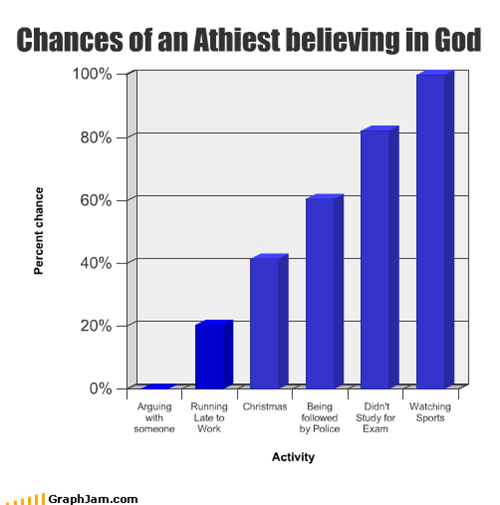
Why Arguing with Atheists is a Waste of Time
This graph from GraphJam heightens my conviction that you can’t really argue people into faith. It’s like trying to argue people into a mystical experience!
Order from Chaos: The Process of Writing

- « Previous Page
- 1
- …
- 120
- 121
- 122
- 123
- 124
- …
- 279
- Next Page »