Anita Mathias: Dreaming Beneath the Spires

Anita Mathias's Blog on Faith and Art

  • Home
  • My Books
  • Meditations
  • Essays
  • Contact
  • About Me

The Colosseum, the Jewish Revolt, the Diaspora, and Christianity

By Anita Mathias

Rome Colosseum


Okay, we did the Colosseum today, partly because it was one of those “When in Rome” things. On reflection, we rather wish that we had done the Basilicas.


However, there is no way to grasp the sheer magnitude of the place without seeing it in real life.


The nearly 2000 year old structure was so solidly built that despite the depredations of earthquakes, fires, riots, war, and the plundering of its apparently inexhaustible supply of ready cut travertine blocks for St. Peter’s, the Barberini and Cancelleria palaces,  and pollution and the vibrations of cars and the metro, it’s still relatively intact. “A noble wreck in ruinous perfection,” Byron called it.


Construction commenced in AD 72 with the booty from Vespasian’s brutal crushing of the Jewish revolt. 

70, 000 Hebrew slaves did the heavy work at the Colosseum, hauling 50,000 cartloads of pre-cut travertine from the quarries at Tivoli 27 km away.

Interestingly, these were the people Paul wrote his letter to the Romans to.

Vespasian chose the site of a lake that lay in front of Nero’s Aureus Doma, Golden Palace, where Nero had erected a Colossus, giant statue, of himself as a Sun God (hence its name).

It was inaugurated in 8 years, a short time for such a massive building by Vespasian’s son, Titus.

Before the building of the Colosseum, gladiatorial and other bloody sports took place in the Forum in wooden stands specially erected and taken down for the occasion.

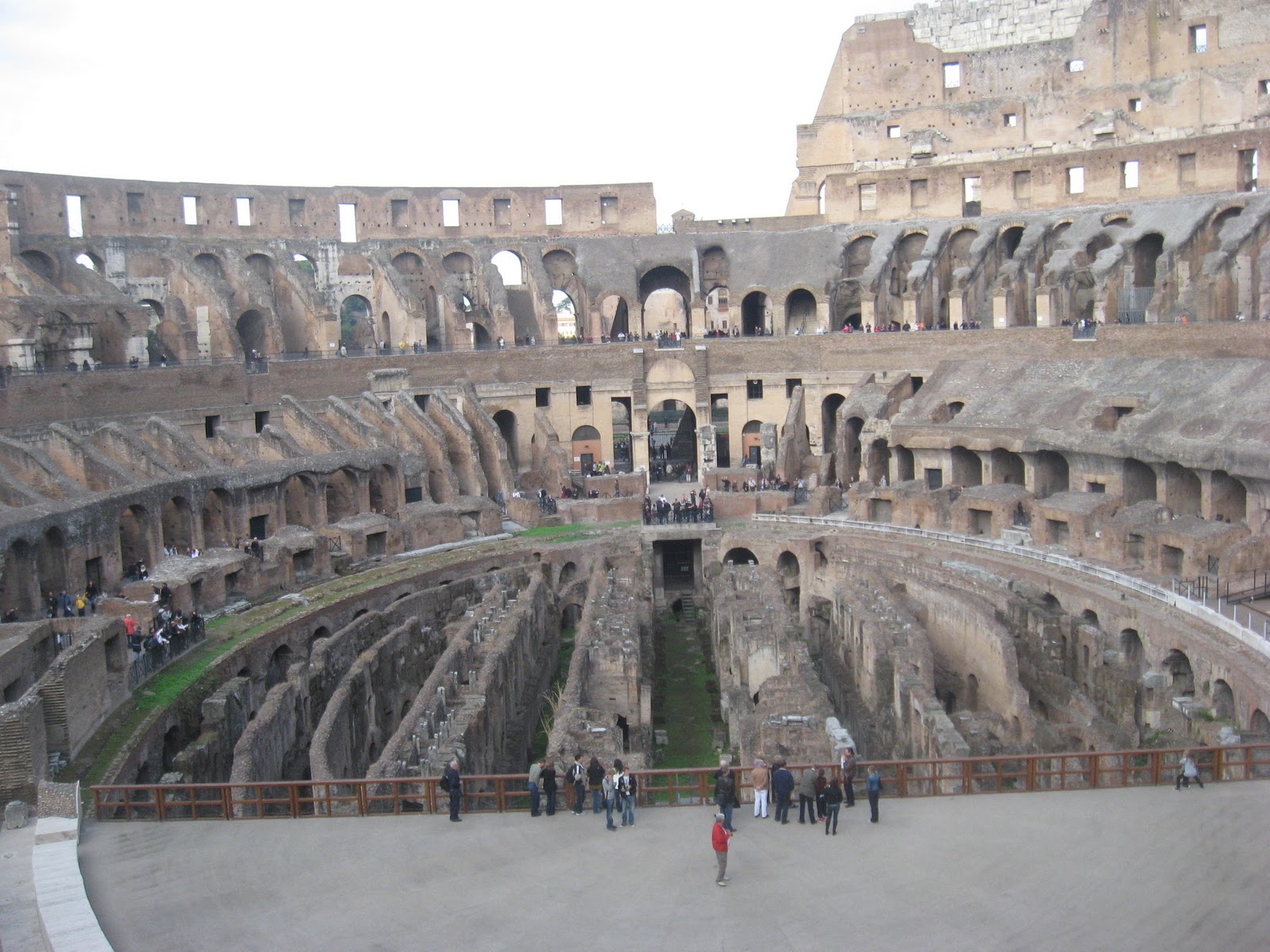
The colosseum was designed over four levels, seating up to 70-80,000 people. “Tickets” were free–carved on wood, with the entrance, row, aisle, and seat under. There were 80 entrances, beneath the magnificent arches. Thus 80,000 people could be seated within minutes, with admirable Roman efficiency (now inherited by the Swiss, Germans and US military??).

The word arena is derived from the Latin for sand, which covered the floor to soak up blood. 

And here, the gladiators greeted Caesar with their famous greeting, “Hail Caesar, we who are about to die, salute you. Ave Caesar! Morituri te salutamus.”

 In the hundred day games that inaugurated the Colosseum, 9000 beasts were massacred, 12 a minute, and during the 450 years it was used, several breeds of African elephants and lions were rendered extinct. 

As Christianity took hold, the gladiatorial games gradually grew less popular. They were eventually banned in 404 AD, and animal fights ended in the next century.

Isn’t it amazing that people who now weep at the suffering of animals could once see bears tied to bulls, fighting to the death, dogs set against wolves, lions taking on tigers, all to the death!

Has Christianity contributed to an evolution and softening of the heart? I hope so. 
                                            * * *

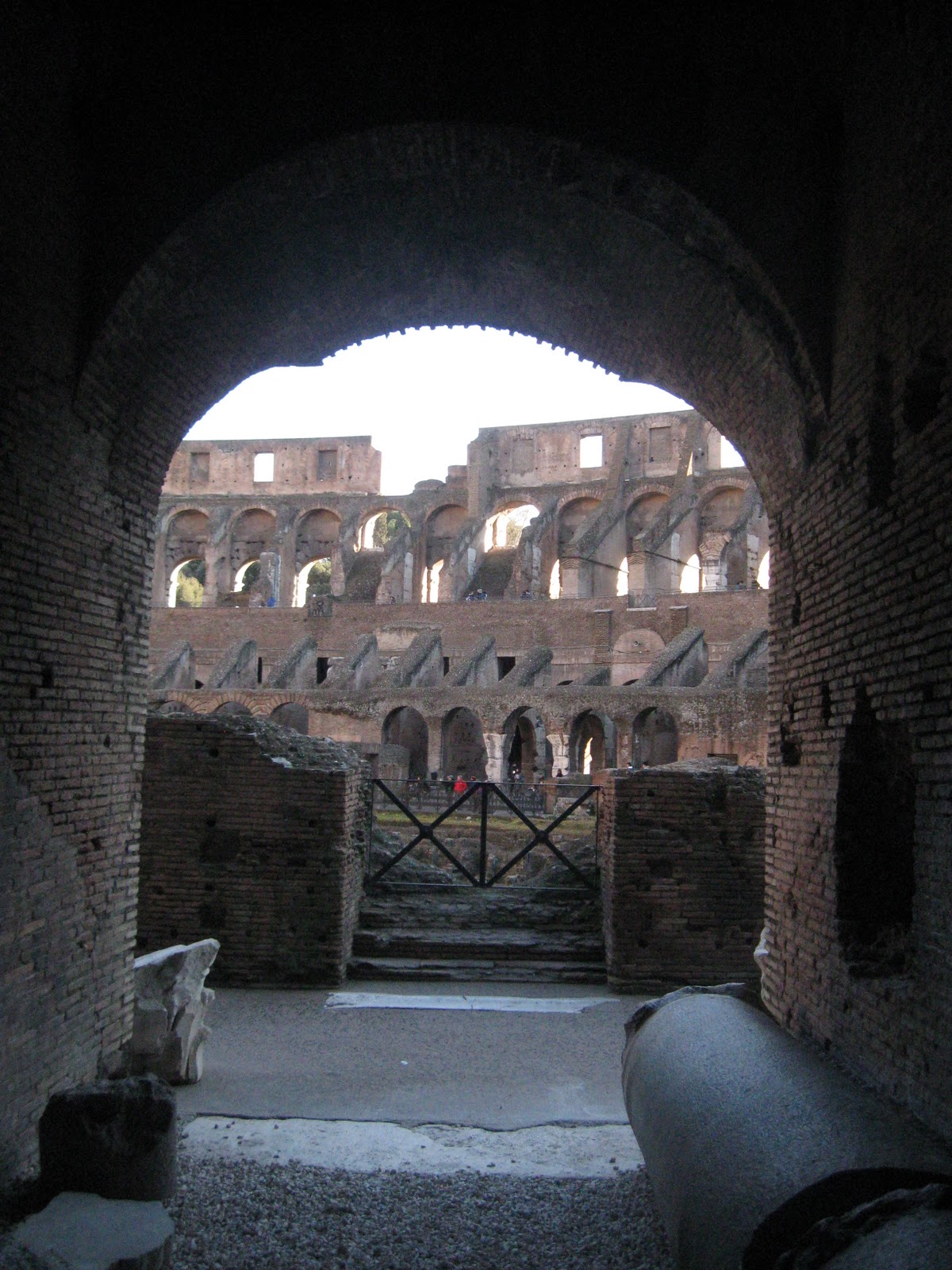
Interior of the Coliseum, with a partially reconstructed arena floor in the foreground

Coliseum — interior archway leading to the arena.


The Jewish historian Josephus who was present at the festivities and the display of the Jewish booty after the crushing of the Jewish revolt writes,

  “As dawn began to break, Titus and Vespasian emerged, crowned in laurel wreaths and wearing the time-honored purple clothes, and walked to the Octavian colonnade. There the Senate, the magistrates and those of Equestrian status were waiting for their arrival.
A tribunal had been erected in front of the colonnade, with ivory chairs placed on it for them. As they walked forward to take their seats, all the soldiers raised an immediate cheer, paying abundant testimony to their valor, while Titus and Vespasian sat unarmed, dressed in silk garments and wearing their laurel wreaths. Vespasian acknowledged their acclaim, and, although they were keen to continue cheering, made a sign for silence. As all fell completely quiet, he rose, and, covering most of his head with a veil, made the traditional prayers. Titus followed him in doing likewise. . . Afterwards, donning the triumphal robes and sacrificing to the gods stationed at the gate, they sent the procession on its way through the theatres to give the crowds a better view.

In Rome, The Arch of Titus
celebrating the Roman
victory over the Jews still stands
It is impossible to do justice in the description of the number of things to be seen and to the magnificence of everything that met the eye, whether in skilled craftsmanship, staggering richness or natural rarity. For almost all the remarkable and valuable objects which have ever been collected, piece by piece, by prosperous people, were on that day massed together, affording a clear demonstration of the might of the Roman Empire. The quantities of silver, gold and ivory, worked into every conceivable form, were not like those usually carried in a triumph, but resembled, as it were, a running river of wealth. Purple cloth of extreme rarity was carried along, some of it fashioned by Babylonian skill into accurate pictorial representations. Translucent gems, embedded in diadems or other objects, were borne in such profusion as to dispel any idea that they were rare. . . In charge of each part of the procession was a number of men in purple and gold costumes, while those selected for the triumph itself wore choice clothes of astonishing richness. Even the prisoners were worth seeing – no disordered mob, but the variety and beauty of their clothes diverted the eye from the disfigurement of their injuries.
The greatest amazement was caused by the floats. Their size gave grounds for alarm about their stability, for many were three or four stories high, and in the richness of their manufacture they provided an astonishing and pleasurable sight. Many were covered in cloth of gold, and worked gold or ivory was fixed on all of them. The war was divided into various aspects and represented in many tableaux which gave a good indication of its character. Here was a fertile land being ravaged, here whole detachments of enemy being slaughtered, others -in flight and others being led off into captivity. Here were walls of colossal size being pounded down by siege-engines, here strongpoints being captured, and here well-defended fortifications overwhelmed. On one float the army could be seen pouring inside the walls, on another was a place running with blood. Others showed defenseless men raising their hands in entreaty, firebrands being hurled at temples or buildings falling on their owners. On yet others were depicted rivers, which, after the destruction and desolation, flowed no longer through tilled fields providing water for men and cattle, but through a land on fire from end to end. It was to such miseries that the Jews doomed themselves by the war. . . Standing on his individual float was the commander of each of the captured cities showing the way he had been taken prisoner. . .

The sack of Jerusalem depicted
on the Arch of Titus
Spoil in abundance was carried past. None of it compared with that taken from the Temple in Jerusalem, a golden table many stones in weight and a golden lamp stand, similarly made, which was quite unlike any object in daily use. A centre shaft rose from a base, and from the shaft thin branches or arms extended, in a pattern very like that of tridents, each wrought at its end into a lamp. There were seven of these lamps, thus emphasizing the honour paid by the Jews to the number seven. A tablet of the Jewish Law was carried last of all the spoil. After it came a large group carrying statues of victory, all of them made of ivory and gold. The procession was completed by Vespasian, and, behind him, Titus. Domitian rode on horseback wearing a beautiful uniform and on a mount that was wonderfully well worth seeing.
The procession ended up at the Temple of Jupiter on the Capitol, where the generals got down. They still had to wait for the traditional moment when the news was brought of the death of the enemy leader. In this case he was Simon, son of Giovas, who had passed in procession with the captives, and had been dragged under the lash, with his head in a noose, to a spot near the Forum. That is the traditional place at Rome for the execution of those condemned to death for war-crimes. When his end was announced and a general cheer had arisen, they started the sacrifices, and after completing them with the customary prayers, they retired to the palace. . .
For on that day the city of Rome made holiday for their victory in the war against the Jews, for the end of civil disorder, and for the rising expectations of peace and prosperity.”

Other trivia: Vespasian partly financed the building of the Colosseum with taxes on using public urinals. The urine was collected and used to dye wool.
When asked by a son how he could bear to make money with such a malodorous substance, he replied, “Pecunia non olet,”–money doesn’t smell. Indeed! 

Click button to share on Facebook, Twitter, Digg, Delicious, Reddit … Wikio


Read my new memoir: Rosaries, Reading, Secrets: A Catholic Childhood in India (US) or UK.
Connect on Facebook: https://www.facebook.com/anitamathiaswriter/
Instagram: https://www.instagram.com/anita.mathias/
Twitter: https://twitter.com/AnitaMathias1
My book of essays: Wandering Between Two Worlds (US) or UK
View our Privacy Policy.
Share:

Related Posts:

  • Always Query Received Wisdom
    Always Query Received Wisdom
  • rp_Transition-Roadable-Aircr-007.jpg
    Flying Cars: The accelerating speed at which…
  • "The Little World of Don Camillo" by Giovanni Guareschi
    "The Little World of Don Camillo" by Giovanni Guareschi
  • Grace and Peace, Paul's Letter to the Romans
    Grace and Peace, Paul's Letter to the Romans

Filed Under: In Which I celebrate Church History and Great Christians

« Previous Post
Next Post »

Sign Up and Get a Free eBook!

Sign up to be emailed my blog posts (one a week) and get the ebook of "Holy Ground," my account of working with Mother Teresa.

Join 536 Other Readers

My Books

Rosaries, Reading, Secrets: A Catholic Childhood in India

Rosaries, Reading Secrets, B&N
USA

UK

Wandering Between Two Worlds: Essays on Faith and Art

Wandering Between Two Worlds
USA

UK

Francesco, Artist of Florence: The Man Who Gave Too Much

Francesco, Artist of Florence
US

UK

The Story of Dirk Willems

The Story of Dirk Willems
US

UK

My Latest Meditation

Anita Mathias: About Me

Anita Mathias

Read my blog on Facebook

Follow me on Twitter

Follow @anitamathias1

Recent Posts

  • At the Cross, God Forgives Us Completely
  • Using God’s Gift of Our Talents: A Path to Joy and Abundance
  • The Kingdom of God is Here Already, Yet Not Yet Here
  • All Those Who Exalt Themselves Will Be Humbled & the Humble Will Be Exalted
  • Christ’s Great Golden Triad to Guide Our Actions and Decisions
  • How Jesus Dealt With Hostility and Enemies
  • Do Not Be Afraid, but Do Be Prudent
  • For Scoundrels, Scallywags, and Rascals—Christ Came
  • How to Lead an Extremely Significant Life
  • Don’t Walk Away From Jesus, but if You Do, He Still Looks at You and Loves You
Premier Digital Awards 2015 - Finalist - Blogger of the year
Runner Up Christian Media Awards 2014 - Tweeter of the year

Categories

What I’m Reading


Wolf Hall
Hilary Mantel

Wolf Hall --  Amazon.com
Amazon.com

Amazon.co.uk

Silence and Honey Cakes:
The Wisdom Of The Desert
Rowan Williams

Silence and Honey Cakes --  Amazon.com
Amazon.com

Amazon.co.uk

The Long Loneliness:
The Autobiography of the Legendary Catholic Social Activist
Dorothy Day

The Long Loneliness --  Amazon.com
Amazon.com

Amazon.co.uk

Country Girl
Edna O'Brien

Country Girl  - Amazon.com
Amazon.com

Amazon.co.uk

Archive by month

My Latest Five Podcast Meditations

INSTAGRAM

anita.mathias

My memoir: Rosaries, Reading, Secrets https://amzn.to/42xgL9t
Oxford, England. Writer, memoirist, podcaster, blogger, Biblical meditation teacher, mum

Looking at photos from our week in beautiful Sevil Looking at photos from our week in beautiful Seville and Cordoba over New Year with Irene, who had a week off.
And, ICYMI, here’s my latest meditation on the Gospel of Matthew… I’ve recorded it, should you want a few minutes of peace.
https://anitamathias.com/2026/04/29/gods-complete-forgiveness/
Hello Friends, I'm resumed recording my meditation Hello Friends, I'm resumed recording my meditations on the Gospel of Matthew. Do click on this link to listen. 
https://anitamathias.com/.../29/gods-complete-forgiveness/
Christ is the most influential figure in the history of the world, though his life ended in shame, humiliation and failure. But he so completely turned things round in his great reversal that the cross on which he died when all seemed hopeless is now the most common, and revered, symbol in history.
He emerged from and was anchored in Judaism. And as the sins of the people were laid on the scapegoat who was sent into the wilderness to perish, Christ died as the lamb of God voluntarily bearing the guilt of the wrongdoing of the whole world. He paid the price for our forgiveness with his life-blood--in accordance with the iron law of the physical and moral universe, of sowing and reaping, cause and effect. 
And so, God, who appeared as flames of fire to Moses, can now dwell within us, purifying us, whose hearts have darkness and shards of ice. 
And now that Christ was crucified, died, but rose again, His Spirit, no longer contained within his earthly body, is poured out like living water onto all humans, at our humble request. The Spirit pours the love of God into us; he reminds us of the words of Jesus and slowly writes Christ’s sweet law on our hearts. This transfusion of grace helps us do hard things we previously couldn’t do. Our dance with the Spirit gradually breaks the power of sin over us. It transforms us.
Now we, the forgiven, protected by the blood of Jesus poured out over us, and filled with His Spirit, who sings within us, Abba, Father, are adopted by God as his children in his joyful new covenant. We are cells grafted into the vine of our new family--Father, Son, Spirit—who now live in us as we live in them. As we choose by our thoughts and actions to continue living in the vine of Jesus, their energy pulsing through us makes us fruitful. And now, all our prayers which flow in the river of God’s good purposes are kindly heard. Waves of love and power flood from the cross! 
Thank you!
Well, hello friends! Breaking radio silence to let Well, hello friends! Breaking radio silence to let you know that I have taped a meditation for you on Christ’s famous Parable of the Talents in Matthew 25. https://anitamathias.com/2025/11/05/using-gods-gift-of-our-talents-a-path-to-joy-and-abundance/
Here you are, click the play button in the blog post for a brief meditation, and some moments of peace, and, perhaps, inspiration in your day 🙂
Hi Friends, I have taped a meditation; do listen a Hi Friends, I have taped a meditation; do listen at this link: https://anitamathias.com/2025/04/08/the-kingdom-of-god-is-here-already-yet-not-yet-here-2/
It’s on the Kingdom of God, of which Christ so often spoke, which is here already—a mysterious, shimmering internal palace in which, in lightning flashes, we experience peace and joy, and yet, of course, not yet fully here. We sense the rainbowed presence of Christ in the song which pulses through creation. Christ strolls into our rooms with his wisdom and guidance, and things change. Our prayers are answered; we are healed; our hearts are strangely warmed. Sometimes.
And yet, we also experience evil within & all around us. Our own sin which can shatter our peace and the trajectory of our lives. And the sins of the world—its greed, dishonesty and environmental destruction.
But in this broken world, we still experience the glory of creation; “coincidences” which accelerate once we start praying, and shalom which envelops us like sudden sunshine. The portals into this Kingdom include repentance, gratitude, meditative breathing, and absolute surrender.
The Kingdom of God is here already. We can experience its beauty, peace and joy today through the presence of the Holy Spirit. But yet, since, in the Apostle Paul’s words, we do not struggle only “against flesh and blood, but against the rulers, against the unseen powers of this dark world and against the spiritual forces of evil,” its fullness still lingers…
Our daughter Zoe was ordained into the Church of E Our daughter Zoe was ordained into the Church of England in June. I have been on a social media break… but … better late than never. Enjoy!
First picture has my sister, Shalini, who kindly flew in from the US. Our lovely cousins Anthony and Sarah flank Zoe in the next picture.
The Bishop of London, Sarah Mullaly, ordained Zoe. You can see her praying that Zoe will be filled with the Holy Spirit!!
And here’s a meditation I’ve recorded, which you might enjoy. The link is also in my profile
https://anitamathias.com/2024/11/07/all-those-who-exalt-themselves-will-be-humbled-the-humble-will-be-exalted/
I have taped a meditation on Jesus statement in Ma I have taped a meditation on Jesus statement in Matthew 23, “For those who exalt themselves will be humbled, and those who humble themselves will be exalted.”
Do listen here. https://anitamathias.com/2024/11/07/all-those-who-exalt-themselves-will-be-humbled-the-humble-will-be-exalted/
Link also in bio.
And so, Jesus states a law of life. Those who broadcast their amazingness will be humbled, since God dislikes—scorns that, as much as people do.  For to trumpet our success, wealth, brilliance, giftedness or popularity is to get distracted from our life’s purpose into worthless activity. Those who love power, who are sure they know best, and who must be the best, will eventually be humbled by God and life. For their focus has shifted from loving God, doing good work, and being a blessing to their family, friends, and the world towards impressing others, being enviable, perhaps famous. These things are houses built on sand, which will crumble when hammered by the waves of old age, infirmity or adversity. 
God resists the proud, Scripture tells us—those who crave the admiration and power which is His alone. So how do we resist pride? We slow down, so that we realise (and repent) when sheer pride sparks our allergies to people, our enmities, our determination to have our own way, or our grandiose ego-driven goals, and ambitions. Once we stop chasing limelight, a great quietness steals over our lives. We no longer need the drug of continual achievement, or to share images of glittering travel, parties, prizes or friends. We just enjoy them quietly. My life is for itself & not for a spectacle, Emerson wrote. And, as Jesus advises, we quit sharp-elbowing ourselves to sit with the shiniest people, but are content to hang out with ordinary people; and then, as Jesus said, we will inevitably, eventually, be summoned higher to the sparkling conversation we craved. 
One day, every knee will bow before the gentle lamb who was slain, now seated on the throne. We will all be silent before him. Let us live gently then, our eyes on Christ, continually asking for his power, his Spirit, and his direction, moving, dancing, in the direction that we sense him move.
Link to new podcast in Bio https://anitamathias.co Link to new podcast in Bio https://anitamathias.com/2024/02/20/how-jesus-dealt-with-hostility-and-enemies/
3 days before his death, Jesus rampages through the commercialised temple, overturning the tables of moneychangers. Who gave you the authority to do these things? his outraged adversaries ask. And Jesus shows us how to answer hostile questions. Slow down. Breathe. Quick arrow prayers!
Your enemies have no power over your life that your Father has not permitted them. Ask your Father for wisdom, remembering: Questions do not need to be answered. Are these questioners worthy of the treasures of your heart? Or would that be feeding pearls to hungry pigs, who might instead devour you?
Questions can contain pitfalls, traps, nooses. Jesus directly answered just three of the 183 questions he was asked, refusing to answer some; answering others with a good question.
But how do we get the inner calm and wisdom to recognise
and sidestep entrapping questions? Long before the day of
testing, practice slow, easy breathing, and tune in to the frequency of the Father. There’s no record of Jesus running, rushing, getting stressed, or lacking peace. He never spoke on his own, he told us, without checking in with the Father. So, no foolish, ill-judged statements. Breathing in the wisdom of the Father beside and within him, he, unintimidated, traps the trappers.
Wisdom begins with training ourselves to slow down and ask
the Father for guidance. Then our calm minds, made perceptive, will help us recognise danger and trick questions, even those coated in flattery, and sidestep them or refuse to answer.
We practice tuning in to heavenly wisdom by practising–asking God questions, and then listening for his answers about the best way to do simple things…organise a home or write. Then, we build upwards, asking for wisdom in more complex things.
Listening for the voice of God before we speak, and asking for a filling of the Spirit, which Jesus calls streams of living water within us, will give us wisdom to know what to say, which, frequently, is nothing at all. It will quieten us with the silence of God, which sings through the world, through sun and stars, sky and flowers.
Especially for @ samheckt Some very imperfect pi Especially for @ samheckt 
Some very imperfect pictures of my labradoodle Merry, and golden retriever Pippi.
And since, I’m on social media, if you are the meditating type, here’s a scriptural meditation on not being afraid, while being prudent. https://anitamathias.com/2024/01/03/do-not-be-afraid-but-do-be-prudent/
A new podcast. Link in bio https://anitamathias.c A new podcast. Link in bio
https://anitamathias.com/2024/01/03/do-not-be-afraid-but-do-be-prudent/
Do Not Be Afraid, but Do Be Prudent
“Do not be afraid,” a dream-angel tells Joseph, to marry Mary, who’s pregnant, though a virgin, for in our magical, God-invaded world, the Spirit has placed God in her. Call the baby Jesus, or The Lord saves, for he will drag people free from the chokehold of their sins.
And Joseph is not afraid. And the angel was right, for a star rose, signalling a new King of the Jews. Astrologers followed it, threatening King Herod, whose chief priests recounted Micah’s 600-year-old prophecy: the Messiah would be born in Bethlehem, as Jesus had just been, while his parents from Nazareth registered for Augustus Caesar’s census of the entire Roman world. 
The Magi worshipped the baby, offering gold. And shepherds came, told by an angel of joy: that the Messiah, a saviour from all that oppresses, had just been born.
Then, suddenly, the dream-angel warned: Flee with the child to Egypt. For Herod plans to kill this baby, forever-King.
Do not be afraid, but still flee? Become a refugee? But lightning-bolt coincidences verified the angel’s first words: The magi with gold for the flight. Shepherds
telling of angels singing of coming inner peace. Joseph flees.
What’s the difference between fear and prudence? Fear is being frozen or panicked by imaginary what-ifs. It tenses our bodies; strains health, sleep and relationships; makes us stingy with ourselves & others; leads to overwork, & time wasted doing pointless things for fear of people’s opinions.
Prudence is wisdom-using our experience & spiritual discernment as we battle the demonic forces of this dark world, in Paul’s phrase.It’s fighting with divinely powerful weapons: truth, righteousness, faith, Scripture & prayer, while surrendering our thoughts to Christ. 
So let’s act prudently, wisely & bravely, silencing fear, while remaining alert to God’s guidance, delivered through inner peace or intuitions of danger and wrongness, our spiritual senses tuned to the Spirit’s “No,” his “Slow,” his “Go,” as cautious as a serpent, protected, while being as gentle as a lamb among wolves.
Follow on Instagram

© 2026 Dreaming Beneath the Spires · All Rights Reserved. · Cookie Policy · Privacy Policy

»
«