John Ruskin: The Most Remarkable Englishman of All Time:
A Mind as Bright and Eccentric as Fireflies!
I spent a happy couple of hours in the Ashmolean’s exhibtion of the Pre-Raphaelites in Italy http://wanderingbetweentwoworlds.blogspot.com/2010/11/pre-raphaelites-in-italy-ashmolean.html and realized again what a seminal and remarkable figure John Ruskin was in the history of England, the history of art, the history of economics, the history of literature, and any number of disciplines.
Ruskin, an only child of doting parents, inherited money. Not a major fortune–his father was a wine-dealer–but enough so that he could afford to buy art (an absolute necessity and addiction for him) and beautiful objects, books, furniture, fossils, marble, houses such as Brantwood–and never need to work.
But work, he did. With furious passion! The Complete Works of Ruskin stretches to 38 volumes–books on flowers and rocks and Florence; on economics and Venice and Amiens, on art and architecture and painting. He knew everything, was interested in everything. He was a man of passion, who lived intensely with intense pleasure. His autobiography, Praeterita, written behind the back of his controlling young cousin and caretaker, who opposed his writing, is a treasure–for what it reveals of Ruskin’s life, mind and thinking, his tumultous life–ten lives in one!!–and Victorian thought.
Though in his last years, he fell into the power of foolish people, Joan and Arthur Severn, who took over his house and abused him while ostensibly caring for him, let us not mourn overmuch, for his intense power of intellectual enjoyment added much joy to his life.
Let me close as Ruskin closes his autobiography, written with a herculean effort even as his last and final breakdown closed in on him, written in despair, summoning up his last efforts of concentration,
“Fonte Branda I last saw with Charles Norton, under the same arches where Dante saw it. We drank of it together, and walked together that evening in the hills above, where the fireflies among the scented thickets shone fitfully in the still undarkened air. How they shone! moving like fine-broken starlight through the purple leaves. How they shone! through the sunset that faded into thunderous night as I entered Siena three days before, the white edges of the thunderous clouds still lighted from the west, and the openly golden sky calm behind the Gate of Siena’s heart, with its still golden words, ‘Cor magis tibi Sena pandit,’ and the fireflies everywhere in sky and cloud rising and falling, mixed with the lightning, and more intense than the stars.”
And how Ruskin’s writing still shines, mixed with fireflies and lightning, and more intense than the stars!
See also http://theoxfordchristian.blogspot.com/2011/02/quest-for-joy-3-fireflies.html
A Wonderful, Vivid Passage from Dicken’s Christmas Carol
Irene, “Dad you MUST take me to school earlier. I am always skinning the flint.” “Skinning the flint?” Arriving just before her name is called out in register. Well, Roy, as a mathematician, is a master of precise calculations.
I am reading The Christmas Carol, Irene said before I could correct. And with great enjoyment and gusto, she read out this passage.
Look at this vivid maximilist style, his sheer joy in writing!!
The Christmas Carol by Charles Dickens.
Oh! But he was a tight-fisted hand at the grind- stone, Scrooge! a squeezing, wrenching, grasping, scraping, clutching, covetous, old sinner! Hard and sharp as flint, from which no steel had ever struck out generous fire; secret, and self-contained, and solitary as an oyster. The cold within him froze his old features, nipped his pointed nose, shriveled his cheek, stiffened his gait; made his eyes red, his thin lips blue and spoke out shrewdly in his grating voice. A frosty rime was on his head, and on his eyebrows, and his wiry chin. He carried his own low temperature always about with him; he iced his office in the dogdays; and didn’t thaw it one degree at Christmas.
External heat and cold had little influence on Scrooge. No warmth could warm, no wintry weather chill him. No wind that blew was bitterer than he, no falling snow was more intent upon its purpose, no pelting rain less open to entreaty. Foul weather didn’t know where to have him. The heaviest rain, and snow, and hail, and sleet, could boast of the advantage over him in only one respect. They often “came down” handsomely, and Scrooge never did.
For the Fallen–Laurence Binyon
For The Fallen
Laurence Binyon
With proud thanksgiving, a mother for her children,
England mourns for her dead across the sea.
Flesh of her flesh they were, spirit of her spirit,
Fallen in the cause of the free.Solemn the drums thrill; Death august and royal
Sings sorrow up into immortal spheres,
There is music in the midst of desolation
And a glory that shines upon our tears.They went with songs to the battle, they were young,
Straight of limb, true of eye, steady and aglow.
They were staunch to the end against odds uncounted;
They fell with their faces to the foe.They shall grow not old, as we that are left grow old:
Age shall not weary them, nor the years contemn.
At the going down of the sun and in the morning
We will remember them.They mingle not with their laughing comrades again;
They sit no more at familiar tables of home;
They have no lot in our labour of the day-time;
They sleep beyond England’s foam.But where our desires are and our hopes profound,
Felt as a well-spring that is hidden from sight,
To the innermost heart of their own land they are known
As the stars are known to the Night;As the stars that shall be bright when we are dust,
Moving in marches upon the heavenly plain;
As the stars that are starry in the time of our darkness,
To the end, to the end, they remain.
Laurence Binyon, 1869-1943, is mainly known for the fourth stanza of this poem, engraved in graveyards throughout England.
Why? Comparing this stanza with the rest can teach us much about good writing–look at its simplicity, its repetition (they shall not grow old, as we that are left are old) the parallelism, (age shall not weary them, nor the years contemn/at the going down of the son and in the morning) and the simplicity of the vocabulary.
The rest does not read so easily, it does not so easily cross the word/understanding/emotion barrier.
Wikio
 Bookmark this on Delicious
Astonishing bursts of creativity: The Blood Flow is Poetry, there’s no Stopping it
The Blood Flow is Poetry: There’s No Stopping It
I think of the wonderful poet Rainer Maria Rilke who gathered up strength and sweetness all his life as he struggled with a writers’ block which lasted for decades, indeed intermittently all his life. And then, in his phraseology, the angel came. And he wrote the beautiful Duino Elegies in an astonishing burst of creative power. Like Handel who wrote the Messiah in three weeks.
Faulker wrote As I Lay Dying in six weeks working six hours a night from midnight to six a.m. Annie Dillard comments on this, “Some people cross the Niagara Falls on a bike. Some eat cars. Who would offend the spirit who hands out such gifts?”
Samuel Johnson wrote his classic Rasselas in a week to pay for his mother’s funeral, creativity blossoming under time pressure. Sylvia Plath wrote her astonishing Ariel poems in her life blood over a period of weeks, “The blood flow is poetry/There’s no stopping it.”
I suppose Van Gogh experienced a similar burst of creativity before his incarceration.
The trick I suppose is to accept God’s gifts of creativity with open hands, flowing with his rhythms so that one can be creative for a long time, and not burn out like Plath or Van Gogh after their bursts of genius.
Diana Holman-Hunt “My Grandmothers and I”
Diana Holman-Hunt—“My Grandmothers and I”
Diana Holman-Hunt’s “My grandmothers and I” is thoroughly enjoyable.
As her name suggests, she is the grand-daughter of William Holman-Hunt who has given us iconic and beloved images like Light of the World. She was also, on her mother’s side, the great-niece of Millais.
Nothing guarantees happiness, of course, not even the most exalted Pre-Raphaelite lineage.
Diana’s father is young, adolescent and absent, in India. She is farmed out between two families–her very wealthy, self-absorbed, coddled, absent-minded maternal grandmother who lived a life of Edwardian privilege in what sounds like the most amazing, romantic and dreamy country house, and her equally wealthy but psychotically stingy paternal grandmother, Mrs. Holman-Hunt.
Mrs Holman-Hunt was a character. She was the painter’s second wife, and bitterly jealous of his first. When things are demanded of her, survival money for instance, she gets tearful thinking of her husband cavorting in heaven with her sister, who again got him first!! Her life is dominated by clever and ingenious shrifts to save money.
Mrs. Holman-Hunt suffers from the mental illness of extreme parsimony, which particularly inflicts the old. (This is perhaps not a well-recognized or diagnosed mental illness, but it should be!!). Her house is full of priceless paintings and precious treasures, all unguarded. Meanwhile, she shepherds her considerable wealth, crying if Diana requires pocket money from her.
Diana invents a style of her own in narrating this charming memoir. First person, present-tense, novelistic techniques (techniques which are commonplace in our generation, of course.)
It reads well, is absolutely winsome and charming, partly because she narrates her poor little rich girl story dispassionately, without self-pity but which much humour.
Bookmark this on Delicious
How Well Read are You? The BBC’s 100 Book Test
How Well-Read are You–BBC’s 100 Book Test
Have you read more than 6 of these books? The BBC believes most people will have read only 6 of the 100 books listed here. . Bold those books you’ve read in their entirety Italicize the ones you started but didn’t finish or read an excerpt.
63 read, 5 on the go or abandoned.
1. Pride and Prejudice – Jane Austen
2 The Lord of the Rings – JRR Tolkien
3 Jane Eyre – Charlotte Bronte
4 Harry Potter series – JK Rowling
5 To Kill a Mockingbird – Harper Lee
6 The Bible
7 Wuthering Heights – Emily Bronte
8 Nineteen Eighty Four – George Orwell
9 His Dark Materials – Philip Pullman
10 Great Expectations – Charles Dickens
11 Little Women – Louisa M Alcott
12 Tess of the D’Urbervilles – Thomas Hardy
13 Catch 22 – Joseph Heller
14 Complete Works of Shakespeare
15 Rebecca – Daphne Du Maurier
16 The Hobbit – JRR Tolkien
17 Birdsong – Sebastian Faulks
19 The Time Traveller’s Wife – Audrey Niffenegger
20 Middlemarch – George Eliot
21 Gone With The Wind – Margaret Mitchell
22 The Great Gatsby – F Scott Fitzgerald
23 Bleak House – Charles Dickens
24 War and Peace – Leo Tolstoy
25 The Hitch Hiker’s Guide to the Galaxy – Douglas Adams
26 Brideshead Revisited – Evelyn Waugh
27 Crime and Punishment – Fyodor Dostoyevsky
28 Grapes of Wrath – John Steinbeck
29 Alice in Wonderland – Lewis Carroll
30 The Wind in the Willows – Kenneth Grahame
31 Anna Karenina – Leo Tolstoy
32 David Copperfield – Charles Dickens
33 Chronicles of Narnia – CS Lewis
34 Emma – Jane Austen
35 Persuasion – Jane Austen
36 The Lion, The Witch and The Wardrobe – CS Lewis
37 The Kite Runner – Khaled Hosseini
38 Captain Corelli’s Mandolin – Louis De Berniere
39 Memoirs of a Geisha – Arthur Golden
40 Winnie the Pooh – AA Milne
41 Animal Farm – George Orwell
42 The Da Vinci Code – Dan Brown
43 One Hundred Years of Solitude – Gabriel Garcia Marquez
44 A Prayer for Owen Meaney – John Irving
45 The Woman in White – Wilkie Collins
46 Anne of Green Gables – LM Montgomery
47 Far From The Madding Crowd – Thomas Hardy
48 The Handmaid’s Tale – Margaret Atwood
49 Lord of the Flies – William Golding
50 Atonement – Ian McEwan
51 Life of Pi – Yann Martel
52 Dune – Frank Herbert
53 Cold Comfort Farm – Stella Gibbons
54 Sense and Sensibility – Jane Austen
55 A Suitable Boy – Vikram Seth
56 The Shadow of the Wind – Carlos Ruiz Zafon
57 A Tale Of Two Cities – Charles Dickens
58 Brave New World – Aldous Huxley
59 The Curious Incident of the Dog in the Night-time – Mark Haddon
60 Love In The Time Of Cholera – Gabriel Garcia Marquez
61 Of Mice and Men – John Steinbeck
62 Lolita – Vladimir Nabokov
63 The Secret History – Donna Tartt
64 The Lovely Bones – Alice Sebold
65 Count of Monte Cristo – Alexandre Dumas
66 On The Road – Jack Kerouac
67 Jude the Obscure – Thomas Hardy
68 Bridget Jones’s Diary – Helen Fielding
69 Midnight’s Children – Salman Rushdie
70 Moby Dick – Herman Melville
71 Oliver Twist – Charles Dickens
72 Dracula – Bram Stoker
73 The Secret Garden – Frances Hodgson Burnett
74 Notes From A Small Island – Bill Bryson
75 Ulysses – James Joyce
76 The Bell Jar – Sylvia Plath
77 Swallows and Amazons – Arthur Ransome
78 Germinal – Emile Zola
79 Vanity Fair – William Makepeace Thackeray
80 Possession – AS Byatt
81 A Christmas Carol – Charles Dickens
82 Cloud Atlas – David Mitchell
83 The Color Purple – Alice Walker
84 The Remains of the Day – Kazuo Ishiguro
85 Madame Bovary – Gustave Flaubert
86 A Fine Balance – Rohinton Mistry
87 Charlotte’s Web – EB White
88 The Five People You Meet In Heaven – Mitch Albom
89 Adventures of Sherlock Holmes – Sir Arthur Conan Doyle
90 The Faraway Tree Collection – Enid Blyton
91 Heart of Darkness – Joseph Conrad
92 The Little Prince – Antoine De Saint-Exupery
93 The Wasp Factory – Iain Banks
94 Watership Down – Richard Adams
95 A Confederacy of Dunces – John Kennedy Toole
96 A Town Like Alice – Nevil Shute
97 The Three Musketeers – Alexandre Dumas
98 Hamlet – William Shakespeare
99 Charlie and the Chocolate Factory – Roald Dahl
100 Les Miserables – Victor Hugo
Harry Potter and the Deathly Hallows
Harry Potter and the Deathly Hallows
Gosh, Harry Potter has been so much a part of our family’s life over the last decade. We started listening to them on tape in 2002 when Irene was not yet 3. When we got into our mini-van, she would demand, “Hally Potter.”
I read the girls all the books, even though both children occasionally had nightmares. We also listened to all the books on tape, even though at times, I turned around, and Irene aged 3 or 4, would be crying, with her hands over a years when Voldemort spoke in hissing tones.
We pre-ordered each book, and I read them all the day they arrived, and then read each one to the kids. They have read them numerous times. I remember the fever of excitement before each arrived, and reading news of the leaks on the net.
We have seen each movie at the theatre the weekend it was released. It’s one of our durable family traditions.
I love the Harry Potter books–characters so real, characters you care about. A gorgeous mish-mash of mythology, languages, history like Narnia. Intricate plots. Brilliant interlinking. I love reading them with bated breath and suspense. I love re-reading them.
J.K. Rowling was a competent student, who went to Essex ( i.e. she was not among the .5 percent of the population who goes to Oxbridge) and wrote these as an unemployed mum (at first!). It makes you wonder how much unrecognised talent there is.
Full many a gem of purest ray serene
The dark unfathom’d caves of ocean bear:
Full many a flower is born to blush unseen,
And waste its sweetness on the desert air.
Some village-Hampden, that with dauntless breast
The little tyrant of his fields withstood,
Some mute inglorious Milton here may rest,
Some Cromwell, guiltless of his country’s blood.
Thomas Gray
Wikio
Andrea Barrett
Andrea Barrett’s “The Littoral Zone” is one of my very favourite short stories. I was intrigued by this Paris Review interview with her.
Andrea Barrett, The Art of Fiction No. 180
Interviewed by Elizabeth Gaffney
When Andrea Barrett won the National Book Award in 1996 for her fifth book and first story collection, Ship Fever, she was not widely known or read. After four critically acclaimed novels that had never budged from the midlist, her then-publisher had declinedShip Fever. And yet it was this collection that became Barrett’s breakout book. Initially, the stories in Ship Fever, which feature scientists as characters and are largely set in past centuries, seemed a radical break with Barrett’s first four novels, Lucid Stars (1988), Secret Harmonies (1989), The Middle Kingdom (1991), and Forms of Water (1993), all of which are set in contemporary times and were noted by critics for their deft handling of family relationships.
Since Ship Fever, Barrett has written a fifth novel, The Voyage of the Narwhal (1998), a tale of Arctic explorers and the families they leave behind, and another collection,Servants of the Map (2002), in which many characters from both Ship Fever and Narwhalrecur. Science has remained a focal point, but the apparent rift between the themes and settings of her early and later work dwindles with each new book. Not only do the scientific themes of the late books have precursors in the early ones—including passages that obsess on invertebrate organisms, aquarium fish, constellations, Chinese medicine, reproductive biology, and ecosystems—but the later books are not half so much about science as they might seem from the jacket copy and reviews. In fact, the web of family relations that interconnects the characters of the first four books is, if anything, denser in the later ones, which have grown together into a kind of extended narrative through their shared characters. Barrett does have a scientist’s fascination for the natural world, but her primary concern is always human character and community. (Her scientists are invariably members of dysfunctional families, too, after all.)
Barrett has received several major prizes and grants, including a National Endowment for the Arts fellowship and a Guggenheim fellowship. In 2001, she was awarded the coveted five-year MacArthur fellowship. In early September of that same year, she arrived in New York City to begin a nine-month stay as a fellow at the New York Public Library’s prestigious Center for Scholars and Writers. Barrett described to me her first encounter with the library’s famous Reading Room; she was sixteen and it was her very first trip to New York City: “I immediately loved the messy, dark rays of brown sunlight slanting in—it was cool. There was that palpable sense of books.” It was to some version of this quiet and profoundly bookish environment that she had planned to return to when she took the fellowship. A few days after her arrival, the Twin Towers were leveled. It turned out to be a terrible and intense year for anyone to be in New York, and not a time when Barrett felt she could sequester herself in a private study and devote herself to researching and writing. She put her novel-in-progress aside for some months.
It was in the context of this personal and general upheaval that we first met, in the spring of 2002, in her sunny sublet loft on the far-West Side of Manhattan. She answered a few follow-up questions by mail, and we met for a second session, almost a year later, in Rochester, New York, where Barrett lives in a two-story red painted house with her husband, Barry Goldstein, a brindled dog, and two cats, one of whom, the stunningly fat and affectionate Spike, purred volubly on the coffee table throughout our conversation. Her house is filled with books and curious objects: a series of antique anatomical prints depicting the human musculature and other body systems, an old-fashioned wooden and brass scientific scale that sits under a glass case in juxtaposition to a green solder-studded motherboard from an old computer hard drive. Her office is upstairs, its walls lined with wooden bookshelves and framed historical prints. The top of her massive oaken desk is actually an operating-room door, salvaged when the hospital where her husband works was upgrading its physical plant for fire-code compliance. But it turns out that that her home office isn’t where Barrett does most of her writing. Her studio is located in an old Rochester post office building, the upper stories of which have been converted into artists’ lofts. She took me by it in her car, pulling into the parking lot and pointing up at a huge, multipaned window. She doesn’t let anyone visit the space, which she referred to as her “sole private sanctum,” now that the success of her books has brought constant telephone calls and requests for her to give readings and teach classes. She was willing to describe it, though: it’s nine hundred square feet and has no telephone or other amenities—not even a computer, though she brings her laptop sometimes—just those great windows, some shelves for books, a chair, and two large wooden tables she got for a song when a nearby university library was replacing its furniture.
INTERVIEWER
What was your family like, growing up?
ANDREA BARRETT
A standard suburban family, pretty much—my father was a real-estate broker who worked in Boston while we lived in Natick and then on Cape Cod. My mother was largely a housewife, until she and my father were divorced. No one in the family read for pleasure—it was a very unintellectual household—but my mother did read to us when we were little, and that’s how I started to read. I read a lot, very passionately, from the time I was very young, but it was a constant battle; my mother would more or less let me be, but with my father I was always searching for a place where he wouldn’t find me. Whenever he saw me reading, he would tell me to put the book down and go outside, act like a normal person. Go play, go fish, go swim, go do something—why are you reading all the time? It was hard for them to understand what drew me to reading so much.
INTERVIEWER
So how do you think you became what you are? Do you think it was innate?
BARRETT
That’s a big question: what is learned versus what is inherited. Nobody in my family does what I do, so who would I have inherited it from? On the other hand, no one taught me to love reading and writing when I was young, so how could I have learned it? Reading feels like something I was born loving. When we lived in Natick, before we moved to the Cape, the Bookmobile would visit our street once a week. I would be starved for that visit all week long, and I’d strip the shelves when it arrived. One driver allowed the children to take books from whatever shelves they could reach, and since I’ve always been tall, I could reach the highest shelf, where all the adult books were, at a pretty young age. That worked well for me.
INTERVIEWER
Do you remember what some of the early books you loved were?
BARRETT
Children’s books at first—Island of the Blue Dolphins and Ramona, the old Helen Hunt Jackson book. Swiss Family Robinson. I loved the editions with the N. C. Wyeth paintings—those glowing frontispieces, and then more illustrations scattered throughout. I readRobinson Crusoe when I was small, of course, and Tom Sawyer and Huck Finn, though neither of those are really children’s books. By the time I was eleven or twelve, I was into more grown-up books.
INTERVIEWER
Did that love of reading mean that you were a strong English student?
BARRETT
No, unfortunately. I got into a lot of trouble as an adolescent, and part of the way that manifested itself was that I skipped school more often than I went to it. By junior high, I was a horrible student. But during my sophomore year of high school, I did have a fabulous English teacher, and I would go to school just for her class and then skip out afterwards. That’s actually when I started writing, although I didn’t think of it, then, as something I might someday do. Mrs. Williams’s way of teaching was to give us an extensive list of really good books to read, and then to have us write, as homework, about the books we chose in a little notebook. We were supposed to do a couple of these a month, but I was doing a half a dozen a week, and she put up with me. Amazing woman—she had her own life and other students, but she’d read whatever I wrote the same night I left it on her desk, and she’d respond in writing, so each notebook became a kind of dual book: a conversation on writing, one passage in my hand and then one in hers, another in mine, another in hers . . .
INTERVIEWER
Did you remain close to her after that class?
BARRETT
For a while, but to my great shame, I lost touch with her after I left the Cape. I didn’t actually finish high school—I went off to college young. I was in such a panic to get away that I went home very seldom for about twenty years, and as a result, I didn’t see her either. But Mrs. Williams was important to me in ways that I didn’t understand for years.
INTERVIEWER
What were some of the other books you read with her?
BARRETT
Lots of Dostoyevsky; lots of Tolstoy, including Anna Karenina. Way too much Kafka, not necessarily a good thing when you’re fifteen, but very seductive. She was very attached to Emerson and Thoreau. So good chunks of them; also some Margaret Fuller, because of the Emerson. Emily Dickinson, Steinbeck, a bit of Kant, more of Montaigne and Rousseau, but almost no English writers. I hardly even knew who the Brontë sisters or Jane Austen were. I had to catch up with all the English writers later, although she did give me a lot of utopian and dystopian literature—everything from Thomas More to Animal Farm and 1984. None of it really stuck, of course. I was too young.
INTERVIEWER
I think it did stick.
BARRETT
Well, I suppose it did, in a miasmatic way.
INTERVIEWER
How did you manage to get into college early, if you were such a bad student, and what was it like?
BARRETT
Despite my bad grades, I had good SATs. And also it was 1970 when I was applying, the tail end of the Hampshire College–Summerhill free-education movement, and everything was still fulminating. People could believe then, in a way they probably wouldn’t now, that maybe I was just doing badly because school was too confining and I wasn’t being properly nourished. Partly, that was true—my school was awful—but it wasn’t just the school. I was also crazy and rebellious. Somehow I got the idea to apply to a couple of colleges in my junior year. Union College very fortunately took me, so I went there. I was able to do about half my coursework there as independent study, which was great, because the only way I really learn is to take a topic and head into a library alone. Retrospectively, I can see that nothing could have been better training for a writer. The downside of that is that I have a spotty education. I know some things that no one would expect me to know, but then I don’t know incredibly obvious things that anyone would expect a writer, or even just a person interested in literature, to know because I never took any English courses. I can’t read a single foreign language comfortably, nor can I speak one, which is embarrassing and annoying. I’m still catching up with my reading. I read Paradise Lost for the first time maybe seven years ago. My Shakespeare is very spotty. Every year I try to read five or six books that I know I should have read in my twenties. There’s some pleasure in reading those now, at this late date. They’re fresh for me, and the experience can be dazzling. It’s an amazing pleasure, it turns out, to read Paradise Lost for the first time at age thirty-eight.
INTERVIEWER
You applied to Union because you wanted to do science.
BARRETT
Yes. They were best known for their engineering and science departments, and I thought I was going to be a biologist. Even though I liked English and biology equally well, I was under the misapprehension that I could learn literature on my own. I knew it would be hard to study biology on my own, but I was unaware of what someone might have been able to teach me about, say, Shakespeare. I had great teachers at Union, and it was fun, but I was in the second class of women—it had been an all-male college—and did feel a little out of place there. I always do.
INTERVIEWER
Do you think this feeling of not being at home is part of what made you into a writer?
BARRETT
Sure. I’ve never known a writer who didn’t feel ill at ease in the world. Have you? We all feel unhoused in some sense. That’s part of why we write. We feel we don’t fit in, that this world is not our world, that though we may move in it, we’re not of it. Different experiences in our lives may enforce or ameliorate that, but I think if they ameliorate it totally, we stop writing. You don’t need to write a novel if you feel at home in the world. We write about the world because it doesn’t make sense to us. Through writing, maybe we can penetrate it, elucidate it, somehow make it comprehensible. If I had ever found the place where I was perfectly at home, who knows what I would have done? Maybe I would have been a biologist after all. No great loss if that had been the case, but it didn’t work out that way.
INTERVIEWER
When did you first start reading contemporary fiction?
BARRETT
Not until late. I had hardly read any before the first time I went to Bread Loaf in 1984.
INTERVIEWER
How did you ever get yourself to Bread Loaf?
BARRETT
I saw an ad in a magazine. I had been wrestling with a novel for five or six years, and after a zillion drafts, I knew it still sucked. I didn’t actually know there were such things as MFA programs, but when I saw an ad for this writer’s conference, I thought, Well, maybe someone there will teach me. So I went to Vermont and discovered all these other people who were also writing. Maybe even more importantly, I met living writers who’d published books, some of whom were women. It was all news to me. I probably couldn’t have named a single contemporary writer when I went there. If you’d asked me who Alice Hoffmann was, or Alice Munro or Richard Bausch, I wouldn’t have been able to place them as to country or century.
INTERVIEWER
Was Bread Loaf a turning point then?
BARRETT
Oh yes, I was incredibly lucky. I had two great teachers that first year, and I made some good friends too. The teachers were Nicholas Delbanco and Thomas Gavin, who were co-teaching a workshop and were both very kind to me. Tom introduced me to Wendy Weil, who’s my agent now. She didn’t take me on right then—I didn’t have anything to show her at the time—but she said, If you finish your book someday, send it to me. Eventually I did, and she’s been my agent ever since.
INTERVIEWER
Was the book you took to Bread Loaf your first published novel?
BARRETT
No, I threw that one out, and the next as well. The other really important thing that happened to me there was something Nick Delbanco said. After my story was workshopped, Nick asked if I had written anything else. Like everyone else up there, I had a novel stuck in my purse, and he read it overnight. It didn’t seem so startling to me at the time, but now that I teach, I know what it’s like at a conference and how inundated one can be. The idea that he sat down and read some idiot girl’s manuscript overnight just flabbergasts me. But he did, and then he sat down with me the next day. He asked me how long I’d been working on it, and I told him six years and a zillion drafts, the whole story. He told me that the workshop story I had written was good and that I had some talent and could probably be a writer if I wanted, but that I had to throw that novel out. He said, You learned to write on it, and it can’t be fixed. He was perfectly right about that. There was no life in it. When I started it, I hadn’t even written any short stories and I quite literally didn’t know where the quotation marks should go, what a paragraph should be, what a sentence was. I didn’t know anything. I give Nick high marks for his bravery and his gentleness and gracefulness in telling me that. Afterwards, I cried for a couple days, and then I threw that novel out. I tried for a while to work on another novel that had all the same problems, and I threw that out too. And then, finally, I was able to write Lucid Stars. I sometimes think I would still be working on that first novel, if not for going to Bread Loaf.
INTERVIEWER
Given your isolation from contemporary writing, how did you ever come up with the idea of beginning a novel yourself?
BARRETT
I don’t know how I got the idea. I just did. And once I started, it seemed really interesting to me. Didn’t all writers do this, until the last thirty years or so? Until MFA programs became so common, people learned by imitation and by reading. If they were lucky, they also learned by conversation with fellow writers, but lots of people didn’t have that at first, either.
INTERVIEWER
I wonder if it isn’t better training to do it the way you did: to read everything except the books that were written last month or last year. Do you remember what exactly you were reading when you decided to begin that first novel?
BARRETT
I was very drawn to E. M. Forster and Ford Madox Ford, and I read a ton of Virginia Woolf, perhaps too much, but I love her. Rebecca West’s novel The Fountain Overflowstaught me a lot. It’s often out of print, but I recently wrote an introduction to a new reprint of it. I also read Elizabeth Bowen, who was especially useful when I was working on more family-oriented material. She’s wicked—and wicked useful. I was explicitly trying to read women writers then, having finally noticed that all the writers I’d been reading were men. It occurred to me only very late that this could be important, that it might make a difference to what I wrote, that I wasn’t a man. Writers seemed neuter to me in some sense. The work was just the work, and it didn’t seem gendered at all: it was just a big sea of words, a sea of stories. I knew nothing about how the stories got made or who was making them or what it would cost to make them, what you would need to do it.
INTERVIEWER
At what point did you give up the idea of becoming a biologist?
BARRETT
I graduated from college in 1974, which with the exception of right now was probably the worst time in the last forty years to be a young person looking for a job. I had been a biology major, and I went very briefly to graduate school in zoology, but then I quit, and after that for a lot of years I was just trying to find anything—any kind of a job. I didn’t have any training. I worked in a biological supply company. I worked in a box factory. I did a zillion other things. Eventually, when I moved to Rochester for the first time, which was in 1978, I settled into medical secretarial work, which seemed like the only plausible choice at the time. I could spell, and I recognized the medical words. If someone dictated humerus, I knew they were talking about a bone. My first job in Rochester was with an Iraqi biochemist who hired me because I could spell the word vacuum. It wasn’t a very good job, and it didn’t pay very well. A big part of it was cleaning up the language in his grant applications. In between, I did the thing that all young people who are trying to be writers do: if I had five minutes free, I’d slip a sheet of paper into the typewriter and try to write a novel.
INTERVIEWER
So you did know at that time that you wanted to be a writer?
BARRETT
Even then—1978, 1979—it still wasn’t clear to me. Certainly I was trying to write, but I didn’t really know what that meant. I knew so little about the world of writing, and I had such a feeble conception of myself and what I was meant to do or be that I don’t think I could have thought, I want to be a writer. It would have seemed too powerful. What I could say was, I want to write this book.
INTERVIEWER
What had you been thinking when you dropped out of graduate school? Did you have a plan?
BARRETT
Does a nervous breakdown count as a plan? Really everything I did during those first years after college was the result of an inadvertent crash and burn, not of a reasoned decision. Panic, terror, depression, hysteria. I left graduate school because I just couldn’t do the work. UMass Amherst is a big state school, and part of being a first-year zoology graduate student there was teaching three sections of freshman zoology lab. Each lab was three hours long and contained twenty-five students, some of whom were Vietnam vets on the GI Bill. Most of the students were older than I was, and they all knew more than I did. I couldn’t make myself stand in front of them and pretend to teach. I’m still bad about speaking in front of people, but at that time it was out of the question. I was so frightened by that, and by the science itself, that I quit. I didn’t even finish my first semester.
INTERVIEWER
Did you go home?
BARRETT
No, I got a job. My first job was working at the biological supply company. My take-home pay was about sixty dollars a week for forty hours. I plated out bacteria onto petri dishes and grew lichens and fed cockroaches and helped prepare skeletons, eventually, which was very cool. Someone collected specimens from the woods—natural death and road kill—but also I think there was some trapping: lizards, salamanders, snakes, things like that. After the cadavers were rough-cleaned and dried, the remains went into big Plexiglas boxes inhabited by large colonies of dermestid beetles, which are scavengers. If the bugs are kept warm and the colony is large enough, they’ll strip a carcass down to clean bone.
INTERVIEWER
That’s fascinating.
BARRETT
It’s fascinating, and it’s really disgusting too. You can’t put a whole dead animal in there or it rots and gets really ugly and smelly, but a rough-cleaned carcass doesn’t have enough fat on it to keep the bugs vigorous, so you also have to put in chunks of suet. The whole arrangement is pretty grotesque. After that, I worked at the box factory. I’ve been trying to write about some of that recently, but it’s really hard.
INTERVIEWER
Is it going into your next book?
BARRETT
Not the beetles. I don’t tend to write very autobiographically anyway, but those couple of years were very intense. I talk about them often, but until now I’ve never written about them. For the last year or so, though, I’ve been trying to see if I could use any of the box-factory material in a story.
INTERVIEWER
But the beetles do pop up, as a potent metaphor, in the Marburg sisters stories. And Henry from The Forms of Water works in a box factory.
BARRETT
That’s true, I touched on that there.
INTERVIEWER
What did you do at the box factory?
BARRETT
I did different things. I started out as the receptionist, working at one of those old, predigital switchboards with the cords you have to plug in and pull out. Then I made my way into what they called sales-service support. Every salesman on the road had a girl—we were always called girls—who took care of his orders. One would call in to say that Anheuser-Busch needed forty thousand boxes with such and such dimensions and printing in certain colors. And with neatly colored pens and perfectly filled out forms, the “girl” wrote up the order. I worked briefly in the factory itself later, which paid a lot better.
INTERVIEWER
Which was worse?
BARRETT
Hard to say. They were bad in different ways. The work was lighter in the office, but it was degrading—the shit we took on the phone, the expected banter, the whole “girl” thing. But factory work is never a picnic either. It was very nineteenth century in some ways—we got turkeys for our bonuses at Christmas. A trailer truck would roll up to the loading dock and two guys would stand on the end of it with frozen Butterballs, tossing them to the milling hoards so we could feed our families for the holiday. I wasn’t writing then, but I wish I had been.
INTERVIEWER
Did you ever think you would end up using that experience to get someplace you wanted to be, or were you just surviving?
BARRETT
That distinction was actually what I was trying to think about when I began writing a story using some of this as material. Most writers I know have done shit work for varying lengths of time, usually when they were writing their first books, but many also knew by then that they were writers, or were going to be writers. There’s a big divide in your life between what you do before you think you’re going to be a writer and what you do afterwards. The work may be the same, but the attitude is different. I lived through those jobs in Massachusetts with no sense that there might ever be anything different or that I might someday be able to “use” the experience. I would get up in the morning and go to the box factory and simply know something was horribly, amazingly wrong. Every day I would say to myself, This is how people live, you have to find a way to make an accommodation to it. Maybe if you work in the factory and not in the office, it’ll be better. You’ll have more money, a better apartment, maybe that’ll be better. I thought that was my life, and I had no sense it was going to change. I did understand that something in me was making it hard to fit in; in ten years, I had about thirteen jobs.
INTERVIEWER
You said you didn’t go home much for twenty years. Your books contain quite a few lost parents, separated siblings, adoptions. Does any of that derive from your own life story?
BARRETT
Writers tend to guard themselves from perceiving that kind of thing, but even I can see those themes in my work. But it’s not autobiography; it’s metaphor. I’m not adopted. Nobody in my family that I’m aware of was adopted, and my family is actually large, blended, and complicated. But that longing and that sense of absence and fragmentation are perhaps other ways of expressing the actualities of my family. Different facts, same emotions.
INTERVIEWER
Does anyone read your early drafts?
BARRETT
Margot Livesey, my dear friend, reads all the drafts of what I write, and I read hers. We have an intense working relationship. I’ve been really lucky to know her. She’s a great reader and teacher as well as an astonishingly good writer. I’m also friends with Thomas Mallon, and sometimes he reads drafts for me as well.
INTERVIEWER
The early feedback doesn’t hamper your creative process?
BARRETT
I trust Margot absolutely. Not only does she not hamper the work, there’s a sense in which I think I write to her or for her. When I feel stuck, I think, Well, if I can just finish the draft, I can show it to Margot and she’ll tell me something. It helps me rather than hinders to know that there’s one person who will read the work with attention and interest. I’m truly fortunate in that. Margot and I are very different writers, not just in our subject matter but in the way we structure novels and stories, the way we think about things. Perhaps the fact that we don’t tend to tread on the same territory has helped us to avoid a sense of rivalry or jealousy. We have different tasks, which means that she reads what I do incredibly clearly. Her strengths tend to be my weaknesses. And sometimes I can bring a different kind of perspective to her work too.
INTERVIEWER
What do you think are the weaknesses in those early drafts of yours?
BARRETT
My early drafts are staggeringly bad. I’m not being falsely modest here, it’s just the way I work, and I’ve had to accept this about myself. The drafts are palimpsests that get deeper and bigger and broader each time I return to them, as the layers accrete. Some of the layers stay and some of them go in the end, but the first drafts are awful, unbelievable. I don’t know how to explain it, except that they have no movement, they don’t go anywhere, there’s no dialogue, nothing happens, they’re shallow, they’re trite. It’s all some kind of strange, wafty cerebration, and I don’t understand where I’m going.
INTERVIEWER
What do you start with? The arc of the story, a character?
BARRETT
If I’m lucky, it’s a character, but it’s usually not. It’s been all different things. It’s usually something much more amorphous than that: a strange, misty pull toward some set of material or a particular place or time or something like a landscape. Sometimes the instigator is both abstract and tiny. The story “Theories of Rain,” for example, came out of reading something about dew and how dew gets formed. That might not seed a story for someone else, but for me, it did.
INTERVIEWER
But wait—how did you get so interested in dew?
BARRETT
Well, I don’t know. Same reason you might be interested in it: because I hike a lot in cold places like the Adirondacks, and if you hike and camp in the mountains, dew is part of life. Even in the summer, it can be ninety degrees in the daytime but forty degrees at night, and when you wake up in the morning, everything’s saturated, soaked, drenched, dripping with cold water. It’s just the dew point in the high mountains. It’s really a sensory thing.
INTERVIEWER
So that sensory experience led you to go read historical writings on dew, which led you to write this story?
BARRETT
The story was shaped as well by coming across the characters of John and William Bartram, early on in my reading about dew. Although the story is fairly short, and there are just a few pages about the Bartrams at the end, in writing it, I probably read as much about those two men as anyone who’s not a Bartram specialist. William Bartram shows up, mentions some frogs, speaks about his pet crow, and then he’s gone—that’s it. So why did I need to read everything that both these naturalists wrote, and why did I need to go visit their house in Philadelphia, and why did I need to go look at all those paintings, and why did I need to read not just their correspondence with each other but with another naturalist named Peter Collinson, and then his correspondence with all sorts of other people? Why do I do that? I don’t know. Not much of it’s in the story, but somehow amid that swirl, the story grows. I can’t really explain it.
INTERVIEWER
Did you do all that research while you were writing the story, explicitly for the story, or was it an interest that preceded and later gave rise to the story?
BARRETT
Most of it was while I was writing. Fairly early on I thought, Oh it would be interesting to do something with all this material on dew and rain, and maybe the Bartrams could be in it. Eventually, the character Lavinia began to surface. She’s the mother of Erasmus Wells, fromThe Voyage of the Narwhal, and I realized that she would have been a young woman when William Bartram was an old man, and that they lived in the same area. There were also huge pauses in the midst of the twenty-odd drafts I wrote when I would just read and read about the Bartrams and then not use any of it. Maybe it’s a delaying tactic, I don’t know. My writing process is mysterious, even to me. It’s slow and inefficient.
INTERVIEWER
You went to the Arctic while you were writing the Narwhal. Was that sort of hands-on research inspirational in the same way?
BARRETT
That happened differently: I got a Guggenheim Fellowship, and I spent the money going to the Arctic, hoping to experience for myself the sensory world I’d been reading about for so long. But I would say I was already between my seventh and eighth drafts of the novel by the time we went.
INTERVIEWER
Had you written the scenes in the Arctic before you went?
BARRETT
Seven times over.
INTERVIEWER
Did you change them extensively after you went?
BARRETT
Not too much, but I made a great many small changes, and these had a large effect, cumulatively. I had avoided going for a long time because I was aware that I couldn’t travel in the Arctic today the same way my characters had, back then. I couldn’t get a wooden sailing ship and sail it through the northwest channel. People go there all the time, now, but they do it with motorboats and helicopters and Zodiacs and so much stuff. I thought if I saw it that way, it might make it impossible to visualize what the journals and letters of the explorers described. I can’t know if the book would have been better if I’d gone earlier, but even going as late as I did was a help.
INTERVIEWER
What gave you the idea to write about a polar expedition in the first place?
BARRETT
It started when I was writing “Ship Fever.” I bumped into a lot of material about the Arctic when I was researching that book because the time it was set in—1847—was pretty much the height of polar exploration. Immigrant ships were coming to North America from Ireland at the same time that fancy English admiralty ships were setting off for the Arctic. I did a lot of reading about the St. Lawrence Seaway for the novella, and as I was researching Grosse Isle, where the quarantine station in “Ship Fever” is located, I came across a mention of the wreck of a ship that had been hit by an iceberg on its return from a polar expedition. I thought, Oh, I should write a story about a polar expedition and put Ned on the ship. For a long time I thought I would pick a real expedition and write about it, but every expedition was wrong for some reason, and after a while I thought it would be best to make one up. At first I thought that this would be a companion novella to “Ship Fever.”
INTERVIEWER
So you don’t always know whether you’re working on a story or a novel when you embark on this sort of elaborate research?
BARRETT
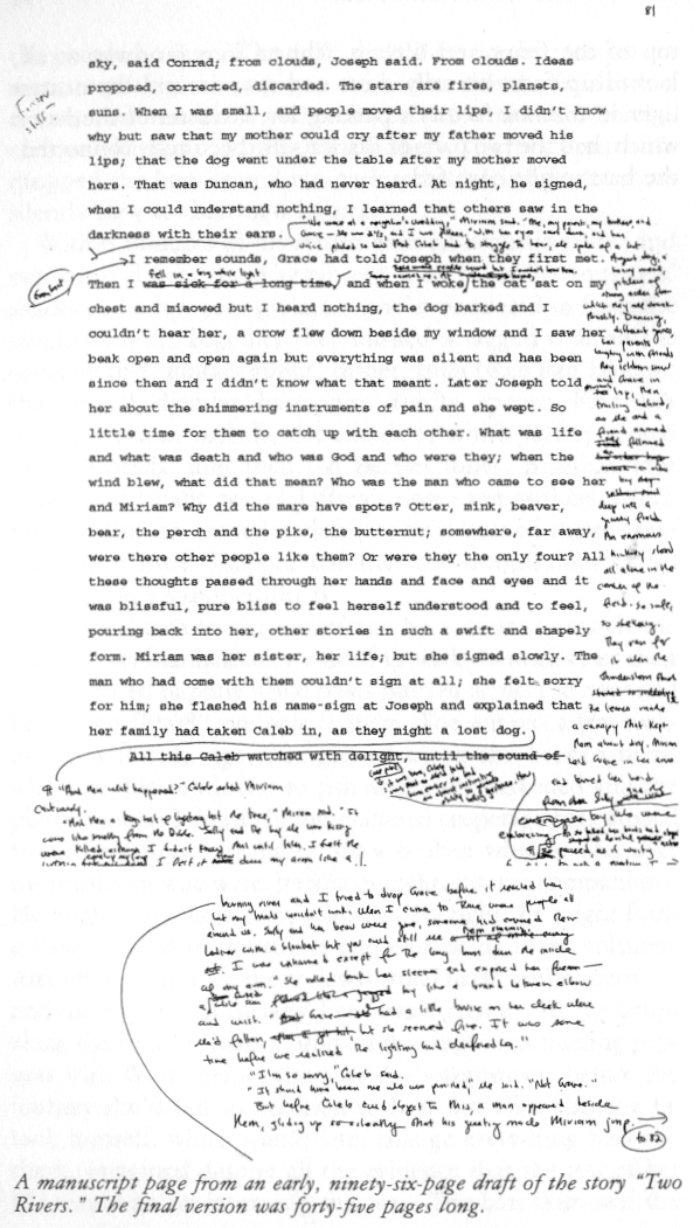
Usually, I do, but sometimes I’m wrong. I never thought The Voyage of the Narwhalwas just a short story, but I thought maybe eighty pages, at first. With the story “Two Rivers,” people told me they thought it should be a novel, but I never agreed.
INTERVIEWER
How long is that one?
BARRETT
Forty-five pages or so. I don’t think of it as a novella, even, but a long story. There probably is too much material in that story, too many pulls in too many directions, too many characters. Writing it was a kind of giant cosmic joke. I spent years running around, looking at fossils, going to museums, learning paleontology, but that’s not actually what the story’s about. Something in me needs to do that.
INTERVIEWER
You’re driven to learn everything you can about the entire world in which a story takes place before you can write it?
BARRETT
Something approaching that, I think. I wouldn’t advocate this as a theory or method of writing, but for me it’s true. I can’t write a character unless I know not just her world and its superficial details but also what she and the other characters are thinking, what they’re reading, what the texture of their interior life is. Sometimes I think that historical fiction goes awry—when it’s not good and you have that faint flavor of cheesiness—because the writer has spent a lot of time learning just the exterior of the world and trying to transmit that to the reader: So and so walked down the street and saw the gaslights of Broadway. They convey all the things that a person of the period could see—and that’s not a bad thing. But it’s not always convincing if you don’t also understand what the person would be thinking about what they were seeing and what they could and couldn’t have known or felt.
INTERVIEWER
Narwhal is about polar exploration, of course, but it’s really crucial to the story and the structure of the book that half of the action takes place back home. It’s not an adventure story, exactly.
BARRETT
I don’t want to go as far as saying that there’s no point in writing a novel that’s just about the exploration—some of those books are very good—but for me there was no point in doing a novel that simply replicated the shape of an expedition. What seemed really interesting was that other half of the story. I wanted to tell a story that contained both the journey and the critique of the journey, the journey and the shadow side of the journey, the men going out and the women back home. For people who don’t like the book, that’s the main thing they complain about. Some Arctic history buffs who were drawn to the book because of its subject really didn’t like the part of the story that takes place back home. They thought it started too slowly and wished I’d left out all the stuff about the women.
INTERVIEWER
In “Servants of the Map,” too, the men go out and travel and the women stay home. Have you ever traveled to India or the Himalaya, where that novella is set?
BARRETT
No, never even close. I’d like to go there, but I probably never will. I get altitude sickness very low, at about eleven thousand feet.
INTERVIEWER
So how did you arrive at the idea for that story?
BARRETT
That goes back to my reading the letters of the Bartrams and Peter Collinson. Through a long chain of references, I found my way to reading about Joseph Dalton Hooker, a botanist who comes up as a character in “Servants of the Map.” He really went to the Himalaya, though he was working on the other side of the range from where my main character, Max, is. In the story, Max writes to Hooker for advice. Hooker actually discovered rhododendrons for the West. He brought boatloads of Himalayan plants back and cultivated them. But I didn’t want to write directly about Hooker or the part of the Himalaya where he was, mostly for political reasons, but also because I wanted to write about the other end of the range, where it meets up with the Karakorum, an area I had always wanted to visit myself. I was very pleased when I first saw the cover of the paperback of Servants of the Map, because the flowers on the jacket were rhododendrons. What I didn’t realize at first was that the art designer had actually dug up an image of Hooker’s rhododendrons—the variety he classified. For me, finding a story is always the result of something bumping into something bumping into something else. This sort of thing is entirely characteristic of me, but there’s no logic behind it. I read a lot. I look at pictures and paintings and the world itself and connections get made and lead to other things.
INTERVIEWER
Right now, it feels like your published work can be divided into two phases: Lucid Stars,Secret Harmonies, The Middle Kingdom, and The Forms of Water—all of which have pretty contemporary settings—and then Ship Fever, The Voyage of the Narwhal, and Servants of the Map. Do you agree?
BARRETT
So many people have asked me that question that I know it must look that way—but to me it doesn’t really feel that way. What it feels like is that slowly, over time—a bit more with each book—I trusted my ability to bring alive characters from other times and places, who were interested and involved in things beyond the narrow confines of my life experience. Even in Lucid Stars and Secret Harmonies, I was relying for metaphor, and for the interests and work experiences of my characters, on things I initially knew little about—astronomy, astrology, music. In The Middle Kingdom I drew on the twentieth-century history of a country I knew essentially nothing about, beyond what I had seen on a three-week visit, and what I could learn from talking to Chinese students once I returned home. The Forms of Water is an extreme example of this—what experiences do I share with an eighty-year-old ex-monk? As little, really, as I do with Linnaeas, who is a character in one of the stories inShip Fever. Well, Brendan, the ex-monk from The Forms of Water, had to be invented in exactly the same way as Linnaeas. But because those earlier books take place at least partly within my own lifetime, and contain some characters who are contemporary women, they look different to readers. Really, the thing that has changed the most, and that does mark a real division between the two groups of books, as you divided them, is that I have had readers for the second group, after having had very few for the first. A result, very largely, of the enormous good fortune of receiving the National Book Award for Ship Fever. The difference is so marked that many people assumed then that Ship Fever was my first book. People sometimes still ask me what it felt like to win such a prize for my very first try.
INTERVIEWER
Looking at the most recent three books, Ship Fever, Narwhal, and Servants of the Map, together, one discovers that so many of the characters are related to each other. The world you study for one story seems to continue on and run over into others. Had you planned that when you first began the stories for Ship Fever?
BARRETT
No, that happened later.
INTERVIEWER
It didn’t seem to me, at the time I first read Ship Fever, that there were links between the stories. Now I realize I missed something.
BARRETT
It only seems that way now, when you look back retrospectively. I made the links later. Since I conceived of The Voyage of the Narwhal as a companion novella to “Ship Fever,” I thought I would carry the character of Ned over. That was the first link, which got built quite accidentally. After that, though, the linkage started to seem interesting. It’s not so uncommon a device, you know, but it is interesting for me as a generator of material. It’s a way for me to keep enlarging my imagined world, to keep knitting this giant mesh together and trying to stretch it out over several centuries. It’s a very good stimulus for writing.
INTERVIEWER
I began to try to draw up a genealogy of your characters, the other night—a map. I realized there were even more connections than I’d thought. I couldn’t keep them straight in my head.
BARRETT
That’s funny—when I first read J. D. Salinger’s Nine Stories and then Franny and Zooey, I had that same impulse. Somewhere on an inside cover of my tattered paperback copies of those books, there are attempts at an overall genealogy. I had great fun doing that. But let me show you something.
INTERVIEWER
What, do you have one of your own?
BARRETT
Nobody’s seen this but my editor and my agent. It’s not completely done yet. [She extracts from a poster tube and unrolls a large sheet of paper with an extensive genealogy chart.] Some of it already exists and some still has to be worked out. It’s a kind of madness. But really it doesn’t matter if anyone else ever sees this or does the sort of map that you made. It’s just important for me.
INTERVIEWER
With the material being shared by so many stories, do you ever find yourself losing track of what the reader of any given story knows?
BARRETT
Yes, it gets very complicated. I also have a file in my computer documenting a kind of über chronology, which starts in 1728 and goes to 2002. It has a few world events, public events—things like the birth of Darwin or the publication of On the Origin of Species—but not many. Mostly it has entries like: Sarah of Rare Bird writes to so-and-so; they leave for Philadelphia; Caleb born; Miriam born—all the way through to crucial events in the lives of Bianca and Rose Marburg. I can’t always keep track of who’s dead or alive in a particular story or novel without it. There are other files I use to remind myself of certain details: Don’t forget that the last time you wrote about Rose, you left her in Hammondsport. I fuck it up too. I make mistakes, contradict myself. If I keep doing this, it’s just going to get worse.
INTERVIEWER
I’m understanding this as a kind of unified field theory, or at least a universe, in which all your fictions would be ultimately related.
BARRETT
They are always related in some sense, because we as authors make those nets of words, those fictions. In an even broader sense, everything that gets written in a certain time and place is related: we’re all alive, we talk to each other, we read each other, things are in the air. For writers like me, who read a lot of older fiction, there are webs and nets that connect the old and the new. So for me to make that explicit through these linked characters is only to take what’s already there and make it more obvious to those reading it. It was there all the time.
INTERVIEWER
Many writers have sustained characters across books or created links between books, but not that many have done what you’re up to. This is not a case of a series.
BARRETT
Yes, you have genre series, you have characters carried over time, you have settings maintained . . .
INTERVIEWER
You have multigenerational sagas.
BARRETT
Right.
INTERVIEWER
But that’s not what you’re doing. For one thing, it crosses over the genres of short fiction and novels, and contemporary and historical settings. Then, too, it’s so subtle. This interconnectedness is never the main issue within any given work, but cumulatively, you are making a point.
BARRETT
I’m trying to make a very quiet point. I’m trying to make the reader feel the effects of genetic linkage, feel the molecules of DNA tumbling across time and space and continents, combining and recombining. Families and people from different cultures marry and have children, who move to other places and marry yet other people; I want to convey a palpable sense of those relationships over time. I want to bring that very lightly to the surface without having it dominate. When this works, it creates a feeling of life that’s hard to imitate any other way. It’s related to the pleasure of a really long book. There is no other way to experience Proust and to have the distinct pleasure of making the connections across time, except to read the whole thing. You have to read it all to get that. The things you feel when reading a long novel are different from what you feel with a shorter work. Maybe that’s also true about the quiet linkages in these books of mine. Ideally, if the connections work, there should be the pleasure of the story or novel alone—seeing that resolved—and then also a faint chime or echo as it ties into other pieces. An additional pleasure that’s available only to someone who’s slogged through everything. If I made the links too overt, though, then the pleasure would be gone.
INTERVIEWER
Are you limited by the parameters of this universe you’ve invented?
BARRETT
Only psychologically. Sometimes I’m tempted to go outside it, but when I get an idea, I very disturbingly find that the next day I have transmuted it so that somehow, however peripherally, it fits into the world I’ve already made. The central character has turned into somebody’s friend or an aunt or an aunt by marriage or a cousin of the friend who was somebody’s aunt. I’ve worried that sooner or later I’m going to box myself into a corner, but I’m not confined by genre, I’m not confined by country, I’m not confined to a century, I’m not confined to a family—so where exactly would the limits of that world be? There’s nothing I can’t make fit in. I’m tracing backward and forward in time all the connections that go into the Marburg sisters’ family—and their friends and various adopted relatives count, too. Well, it does leave me a lot of room. There’s no sense of confinement. The universe is bigger than I can understand, bigger than I can write about, so I don’t feel boxed in yet. Or at most by my own inability to understand it all, to keep it clear in my head all the time, but never by the size of the box.
INTERVIEWER
Can you say which characters from your previous books are recurring in your new one? Is there a lot of science?
BARRETT
There are some characters that are new, but the main character that you would have some knowledge of is Bianca and Rose Marburg’s grandfather, Leo. He’s one of the central characters. There’s also another important person that you’ve met, though only in the most glancing way: the granddaughter that Nora from “Ship Fever” and “The Cure” doesn’t live to see. At the end of “The Cure,” as Elizabeth goes to visit her sister and brother-in-law, there’s a moment where the kids sweep by—there are five of them—and the youngest is Eudora, who is part of the new novel. The present-time action takes place in 1916 and 1917 at a public sanatorium in the Adirondacks.
INTERVIEWER
Do you have a working title?
BARRETT
Right now, it’s called “The Experiment.”
INTERVIEWER
Given the existence of this whole fictional universe and its timeline, do you already know what happens at the end?
BARRETT
I know how it ends.
INTERVIEWER
Do you ever have trouble keeping your own interest alive without the suspense of not knowing?
BARRETT
No, because that’s not the sort of thing I’m doing when I write. I’m not trying to find out who will get married to whom. A lot of the suspense in writing is structural, formal, the surprise of the characters’ inner lives. I think most readers are also looking for these other surprises. We know someone will die or get married; what intrigues us is how we’ll get there. What’s the path? Writing is suspenseful for me because I have to figure out the path. But the kind of suspense that has to do with plotting has never driven me. I’m a feeble plotter—you can look at my books and see that they’re not about that. I’m a fairly good student in certain ways, but I haven’t been able to learn how to plot. In a sense, I’d say I haven’t yet learned how to write, either. I may solve the problems presented by one book, but then I find that the next book is totally different, and I have to start all over again. With the book I’m working on now, I’ve felt this very sharply. I was interrupted in my work by a year-long stay in New York, which was dominated by the events of 9/11. Now that I’m back to it, I feel like a beginner all over again. Sometimes that’s excruciating, but it’s also fun. I simply can’t learn how to do it. It seems impossible that after seven books I wouldn’t have learned how, but I haven’t.
INTERVIEWER
But what would it mean to have learned to write in this sense? Your first draft would also be your final draft?
BARRETT
I guess. I always imagine that. I also imagine that there’s some secret to writing, and no one will tell me what it is. I know it’s not true, but still, despite all the evidence to the contrary, all the years of working on my books, part of me does still feel that if I ever really learned how to do this, I would stop writing such crazy material, such bad first drafts, and get it right the first time.
INTERVIEWER
That would be channeling a muse. That would be Rilke’s Sonnets to Orpheus. That kind of writing is exceedingly rare.
BARRETT
I know it’s not realistic. It’s the dream of paradise. The dream of waking up and without effort being able to produce perfection.
INTERVIEWER
It might actually be boring. Weren’t you just saying you write because the process of doing it is so satisfying in itself?
BARRETT
Yes, probably I’d be miserable if the dream ever happened. Often I don’t enjoy the struggle, but at the same time part of the reason I like doing it is the difficulty. There’s some evidence that I actually make it harder for myself—for example, by tying so many things together or doing much more research than I need to do. It’s as if when I don’t feel the going is hard enough, I create another set of constraints. One of the ways that this new book seemed to go wrong for me in the beginning was that I started to write it pretty much like I wrote The Voyage of the Narwahl—it had an omniscient narrator and moved through four or five central consciousnesses. The problem was, I got bored. I don’t think it was the right voice for this material, in the end, but I was also bored because I already knew how to do that. Maybe not perfectly, maybe not as well as I might wish, but I had done it a couple of times already, and I felt I could do it with some ease.
INTERVIEWER
Paradise got too close.
BARRETT
Apparently.
INTERVIEWER
You told me earlier that the voice of the new book is very quirky. Can you say more?
BARRETT
I hardly know how to describe it right now. It’s a collective first-person narrator that also fragments into some individual voices, including an X-ray technician, a doctor, and certain patients in the sanatorium who are involved in the experiment of the title.
INTERVIEWER
I’m trying to think of other books that have taken on this first-person-plural point of view. There’s the fairly recent example of Jeff Eugenides . . .
BARRETT
He did it beautifully in The Virgin Suicides. In so far as I remember, he was working after the model of Faulkner’s A Rose for Emily. Which is to say the group of people functions as a collective witness, in some sense. There’s also During the Reign of the Queen of Persia by Joan Chase. I haven’t read it in years, but it’s a beautiful book. I did a little bit of this in my story “The Marburg Sisters.” I don’t know if what I’m doing with the voice in the new book is going to work yet, but I can do certain things with it that I can’t do any other way. I can really give a sense of what it’s like to be in an institution—not just one person’s experience but everybody’s. But it’s daunting. The voice is very natural for the things that happen inside that sanatorium, but there are going to be some huge events that have to happen outside that voice.
INTERVIEWER
So are you doing any reading to get ideas for the collective first-person plural voice?
BARRETT
No. I don’t know of anyone who’s done quite what I want to do, and I’m afraid to look at too many examples. I love what Jeff Eugenides does in The Virgin Suicides, and at some point, I will go back and look at it, but it’s not what I want to do in my book.
INTERVIEWER
What’s the experiment referred to by the title?
BARRETT
It’s a little communal school or self-educational gathering, people getting together to tell each other what they know and give lectures to each other.
INTERVIEWER
I had imagined a medical experiment, what with the X-ray technician and your penchant for scientists as characters.
BARRETT
No, it’s more of a utopian social experiment, at least at first.
INTERVIEWER
Do titles come easily for you?
BARRETT
I always love to see a fabulous nine-word title—a big, descriptive, mysterious title likeWhy the Tree Loves the Axe. I often try them out for myself, but then I realize my own are wafty and pretentious. I know the Narwhal went through many lofty titles. At some point I was calling it “The Cave Beyond the Winds.”
INTERVIEWER
Do you usually have the title early?
BARRETT
It depends. Sometimes I do; sometimes I haven’t found it till the last moment. WithServants of the Map, I always had the title for the story, but I never thought of it as the title for the whole collection, and then one day it suddenly seemed abundantly obvious—not just because that was the name of a long story in the book, but because it spoke to so many issues in the other stories. The Voyage of the Narwhal came late, too, but it was clear, once the book within the book, which is also called The Voyage of the Narwhal, came up.
INTERVIEWER
What about Ship Fever?
BARRETT
I always loved that phrase—it’s another name for typhus—but I didn’t know it was the title of the book for a long time.
INTERVIEWER
“The Mysteries of Ubiquitin” is a great title.
BARRETT
That one came out of a conversation with a friend of mine who studies ubiquitin, which is a protein, and who taught me everything about it that’s in that story. We were sitting around nattering one day, and one of us said laughingly to the other, Oh, the mysteries of ubiquitin.
INTERVIEWER
What’s your writing day like?
BARRETT
It depends. If things are lined up and I’m ahead of myself in terms of research, I’ll write in the morning, and then sort of gather stuff together in the afternoon. Say if I’m going to write about rhododendrons, I’ll get together all the stuff about rhododendrons in the house. And then I read it over in the afternoon or evening and try to write the passage the following morning. But sometimes, when I’m stuck, a scene will get to the point where I can’t write the next sentence because I don’t know something. What I just described is how I wrote Voyageand Servants of the Map and a few stories before that. My days are not as rigidly planned out now as they used to be. I travel too much. I’m always going off to give readings or to teach. I’m trying to get back to being more flexible—the way I was when I was younger, because I had to be. That little stretch of years when I was home enough and quiet enough that I could be quite firm about my schedule seems to be over, unfortunately. I don’t have that luxury right now, but I didn’t have it when I was working on my first books, and they still got written.
INTERVIEWER
Do you start out in longhand or on a computer?
BARRETT
I often compose on the computer, but I still work longhand as well. I print out a lot—it’s very tree destructive. I type my horrible early drafts and print them out and write all over them. Once they’re covered with handwriting to the point I can’t read them, I type the changes in and print again, and then I work on the pages again. The computer has saved me some time in terms of moving chunks around. Very often I move material between chapters. I never get the chapters right—they’re always in the wrong order and I have to swap things around. Sometimes I retype from scratch, or I may even hand write from scratch. I read the pages aloud when I’m stuck in a certain way, which is part of why I have the writing studio. When Barry’s home, I can’t work in my office upstairs. I’m sorry I wouldn’t show the studio to you, but I feel I need to keep a physical as well as a psychic space that can’t be violated.
INTERVIEWER
Has your choice of historical settings and characters for your later books spared you some of the curiosity of the reading public?
BARRETT
Sure. In general, I would say that writing about the past provides a considerable defense against the confusion of autobiography and fiction. Any time someone writes a contemporary novel, no matter how different the author is from the characters, that question comes up. The only time people get close to asking me if my work is autobiographical is with the Marburg sisters. They’ll say, Are you more like Rose or Bianca? But people never ask me if I’m more like Linnaeas or Mendel.
INTERVIEWER
All right, which are you more like, Linnaeas or Mendel?
BARRETT
Oh—Mendel.
INTERVIEWER
Why?
BARRETT
He was very solitary, and not very willful. He had enough will to do his work but he didn’t have the confidence to push his work out into the world.
INTERVIEWER
You have written about many characters engaged in various sorts of Linnaean classification, scientists, and otherwise, and yet it’s not really the way you think, as a writer, not the way you organize the world.
BARRETT
That’s true. My own mental processes are far more intuitive than logical, more chaotic than linear. It’s far easier for me to put things together—to synthesize, to make patterns—than to analyze. I think part of the reason I’m so fascinated by characters who think very clearly, perhaps to the exclusion of other aspects of their lives, is that I don’t think clearly at all myself. Not properly speaking, anyway.
INTERVIEWER
Why do you think people are interested in whether fiction is autobiographical?
BARRETT
I don’t know. I have to accept that they are, because I run into it everywhere. Writing is so personal. There’s so much of us in our fiction, whether we draw on the facts of our lives or not. Our hearts and spirits are in there—everything that’s important—it seems like this should be enough, but apparently it’s not.
INTERVIEWER
Are you ever curious about other writers’ lives and books in that way?
BARRETT
Yes, which is another reason I understand it. There are writers I love so much that I want to know anything I can about them. Then I’m forced to examine that impulse. I think about all the reading I did as a girl and as a young woman—I never had to know what George Eliot and Tolstoy had for lunch. I didn’t care. So why do I want to know these things now? Why are people curious about these things? I don’t know, though I’m as subject to that impulse as anyone else. In my own case, I can say with certainty that I’m much less interesting than my work is. I know there are writers who are themselves wonderfully interesting people. But there’s a sense in which I’m just the tunnel through which this stuff passes. There’s nothing very interesting about a clay tube.
INTERVIEWER
Except before you were saying how much work it is.
BARRETT
Even so, what I do remains as opaque to me as it does to you. Stuff goes in at one end, and both you and I can see what emerges at the other end of the process. I’m aware that somewhere in this bloody darkness in between, something goes on, but I am not hugely more in touch with the process than you are. It takes up all my time—it has eaten my whole life—and it’s endlessly interesting to me, but I can’t explain it. It’s just what I do.
INTERVIEWER
Is it fun?
BARRETT
When a plant grows, is it fun for the plant? Fun isn’t really the right word for it. Is grass having fun? There’s a seed, you put it in dirt, water it, and shoots unfold. If it happened really fast, like with bamboo, it might be fun to watch, but is it fun for the bamboo? It’s the wrong question. Is it essential? Absolutely. Can I live without doing it? Apparently not.
INTERVIEWER
What are you reading now?
BARRETT
I’m reading Ford Madox Ford’s Parade’s End, which I’d never read before, though I loveThe Good Soldier. The first volume is fabulous, if hard to get into. I’d tried to read it a couple times in the past and hated it. That’s a great example of how you can come to a book at a certain time in your life and it actively repels you, but then one day you’re old enough or it’s the right weather, and it’s completely transparent. I just finished One of Ours by Willa Cather. It’s not her best book—it wasn’t transfiguring, the way some Cather is—but you know, even bad Willa Cather is better than almost anybody else. I’m also reading Sebald’sThe Rings of Saturn for the third time, for a technical reason—I want to see how he’s jiggling the transitions between the layers of story. He does this thing where he’s walking along, talking to someone who’s telling him a story, and then in that story, we meet someone else who tells another story. I wanted to see how he shuttled between them. The first two times I read it, I was so happy to be reading it that I couldn’t pay attention to that sort of thing. I also recently reread Virginia Woolf’s The Voyage Out, which I was interested in for a similar reason. Then there’s The Radetsky March by Joseph Roth. I was looking at the first chapter, which covers thirty years in eighteen pages, very gracefully, for a class at Warren Wilson. Once I’d dipped in, I had to reread the whole book. Most of what I’m reading now has to do actively or peripherally with World War I—it’s either set in or was written around that time, since that’s the period I’m working with now.
INTERVIEWER
Your formal education wasn’t in literature or writing, but it served you well. What do you think about the extent to which writing can be taught?
BARRETT
I think sometimes people misperceive me as a self-taught writer, but that’s true only in the bluntest sense. I’ve learned a great deal from teaching at Bread Loaf and Warren Wilson and from all the friends I’ve made at both places.
INTERVIEWER
I can grant that you might have learned a lot from teaching, but you’d written four books before that, not to mention the two you threw out.
BARRETT
That’s certainly the case, but I wouldn’t have been able to write the stories in Ship Feveror Servants of the Map if I hadn’t been at Warren Wilson. I heard such interesting craft lectures there from the other teachers and learned a lot from my students, too—from their fiction and their critical work. Then there’s everything that I was desperately reading just to keep a half an hour ahead of them, and everything I was reading to be able to teach a good craft class there—one hour that takes me six months of preparation. The stories in Ship Fever are rooted not just in their subject matter but in certain technical challenges that I explored at Warren Wilson.
INTERVIEWER
So teaching and hearing other writers teach has taught you what the available repertoire of tricks is—that you could do an arabesque?
BARRETT
I don’t think it’s so much taught me how to do an arabesque but that there was such a thing. If I’d been doing one before, I hadn’t known the name for it or how to refine it. Once I discovered there was this thing called an arabesque, I could also think, But this story would be much better if I could do a triple! I became much more conscious of the technical aspects of writing. There’s a good deal you can do unconsciously, without really knowing what it is or how you’re doing it, and I had learned much of that before I began to teach. But teaching forced me to articulate back to people what I was doing, and in the process to grow clearer about it myself. For someone not naturally a clear thinker, this is quite useful.
INTERVIEWER
What about the workshop experience—do you think writing students get anything out of it?
BARRETT
Well, a bunch of my students have been published, so something must have worked for them. Was it the workshop? I’m not sure. For some writers, it’s definitely helpful. Sometimes I think drawing up a really good reading list is the best thing that I can do for a writer. If you know a writer’s work well enough to provide the right reading suggestions, and they take those seriously and do the reading, that will work. Anyone who’s going to be any good will learn from that. It’s the one thing you can give other writers that’s universally helpful. Once they learn to see what other writers have done and how, they realize they can steal those techniques. I tell them, Yeah, steal that. Go there, and make it yours.
- « Previous Page
- 1
- …
- 3
- 4
- 5
- 6
- 7
- …
- 22
- Next Page »